
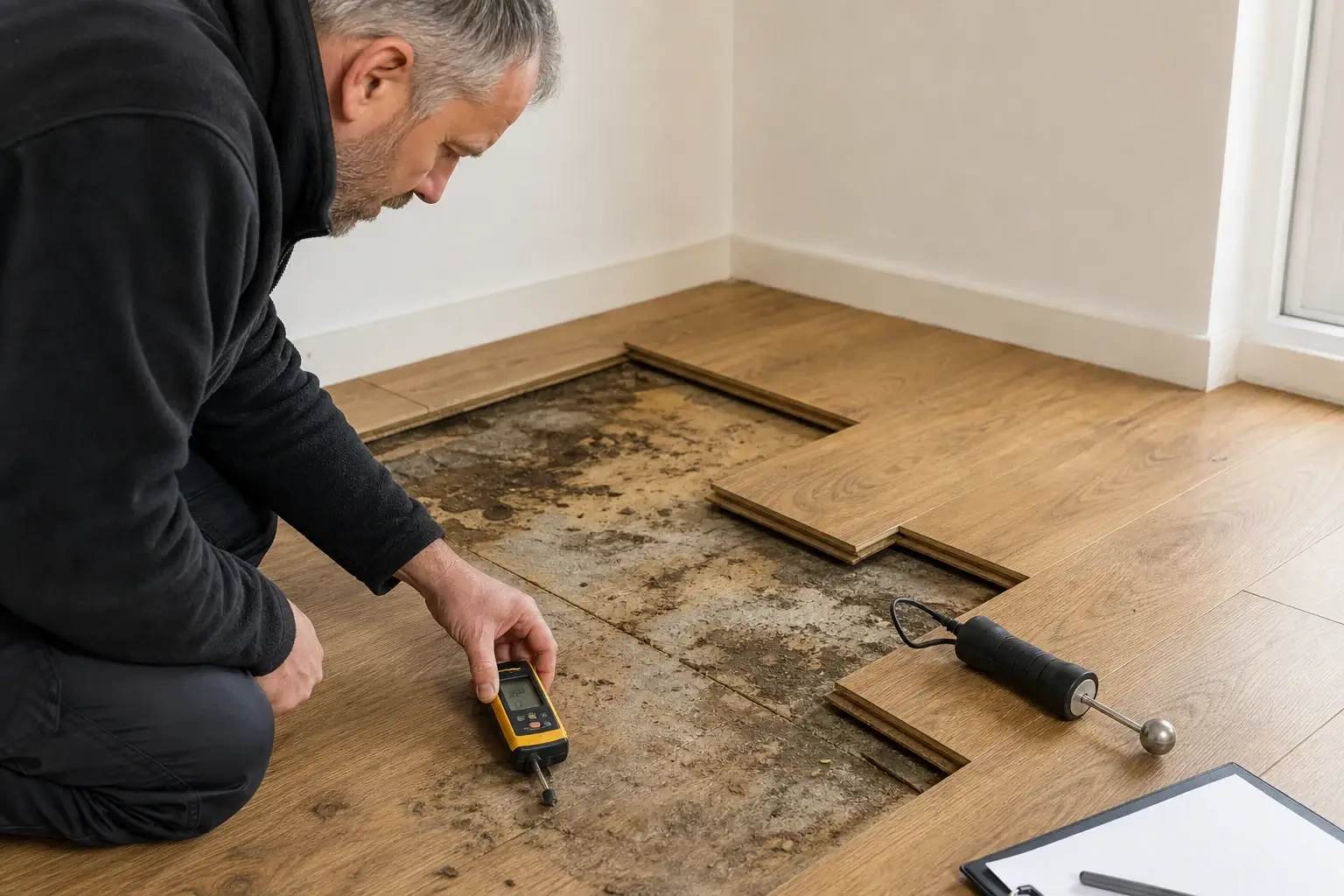
Moisture damage in flooring often starts quietly. A slight change in appearance, a bit of movement underfoot or an unusual smell may be the first clue that something below the surface is not right.
This checklist is designed to help homeowners spot early warning signs before a minor issue turns into a larger, more expensive problem. The same visible symptom can have more than one cause, so the aim here is not to diagnose the floor from a distance, but to help you recognise when further investigation may be sensible.
Check the floor surface for early visible changes
- Look for staining or discolouration. Dark patches, pale marks, tide lines or uneven colour can suggest moisture has affected the flooring or something beneath it.
- Watch for edge lift or curling. If boards, planks or sheet flooring start to lift at the edges, moisture movement may be one possible cause.
- Notice any cupping, crowning or warping. In timber floors, changes in shape can indicate the boards are responding to moisture and humidity changes, although installation or subfloor issues may also play a part.
- Check for rippling or raised areas. With carpet, a changed appearance may reflect moisture affecting the backing, underlay or subfloor rather than the carpet itself.
If you want to understand how moisture problems can appear after installation, see why moisture problems can show up after a new floor is installed.
Feel for movement, softness or a change underfoot
- Walk slowly across the room. A hollow sound, bounce, soft spot or slight movement can indicate a problem with the flooring, adhesive bond or subfloor below.
- Notice any boards that feel unstable. Timber flooring that lifts or moves may be reacting to moisture, but the cause could also involve fixing methods, expansion gaps or substrate condition.
- Pay attention to localised changes. If the problem is limited to one area, it may help to identify where moisture is entering or accumulating.
For a more detailed explanation of this type of symptom, you may find why flooring can sound hollow or feel loose after installation useful.
Look and listen for moisture-related clues around the room
- Check skirting edges and joins. Lift, gaps, swelling or changes at the perimeter can sometimes be linked to moisture movement.
- Smell for mustiness or damp odour. A persistent odour is not proof of a flooring defect, but it can be a sign that moisture is present somewhere in the build-up.
- Inspect nearby walls, doors and thresholds. Moisture issues do not always begin in the middle of the room; they may show up first at vulnerable junctions.
Condensation can also affect flooring performance in colder periods, particularly where ventilation or temperature conditions change. If that may be relevant, read why condensation can affect flooring performance in colder weather.
Do not overlook the subfloor
The visible floor is often only part of the picture. Moisture-related problems may originate in the subfloor, screed, timber base or the surrounding environment.
- Concrete or screed subfloors may retain moisture for longer than expected if they were not ready for floor installation.
- Timber subfloors can be affected by leaks, poor ventilation or seasonal moisture changes.
- Residual contamination or poor preparation can make a floor more vulnerable to failure when moisture is present.
If the floor problem appeared after installation, it is worth reviewing whether the substrate was suitable in the first place. The guide on moisture-related flooring problems before they become more serious may also help you recognise patterns worth documenting.
Record the signs before they change
- Take clear photos in good light from several angles.
- Note when the issue first appeared and whether it is getting worse.
- Record where the damage is located and whether it is isolated or widespread.
- Keep details of any leaks, spills, heating changes or weather events that may be relevant.
- Do not start removing flooring unless you already know it is safe and necessary to do so.
Good records can be useful if you later need to raise a complaint, speak to a contractor or request an independent assessment. This is especially important where responsibility is being questioned. If that is the stage you are at, what evidence to gather before asking for an independent flooring inspection is worth reading.
When an impartial inspection may be the sensible next step
Not every sign of moisture means the floor has failed, and not every defect is caused by moisture. But if the problem is spreading, if the floor is moving, or if no one can agree on the cause, an independent flooring inspection can help establish what is happening and why.
The Flooring Inspector carries out impartial inspections across England, Scotland and Wales, including wood and timber floors, carpets, subfloors and moisture-related flooring problems. Where appropriate, a formal written report can set out the findings and practical recommendations in clear, evidence-based terms.
If you are unsure whether your issue needs technical investigation or a simple complaint, how to tell whether a flooring problem needs an independent inspection or just a complaint may help you decide the next step.
When moisture damage in flooring is caught early, there is usually more scope to understand the cause and limit further deterioration. The key is to act on the signs you can see, rather than waiting for the problem to become obvious to everyone else.