
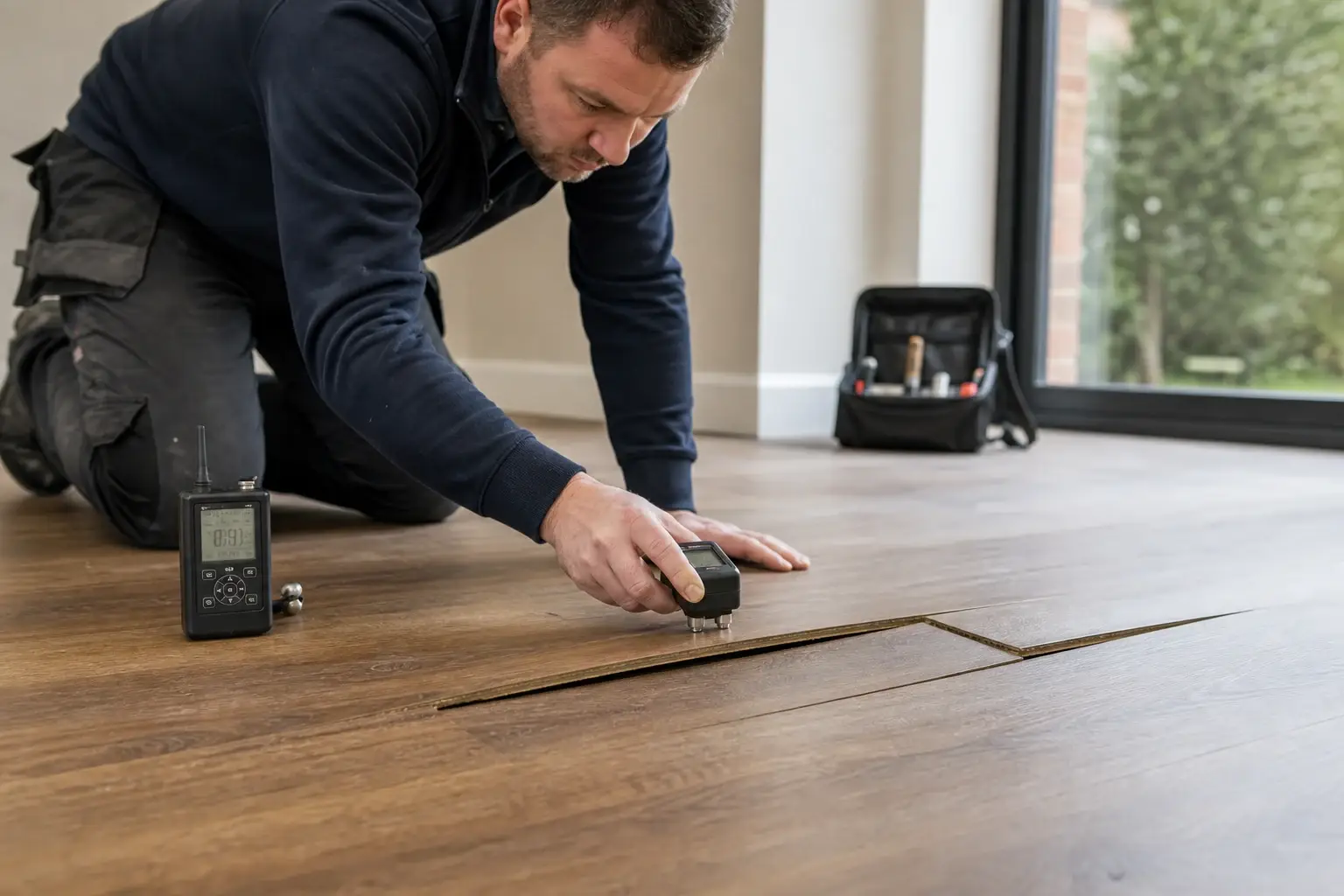
Small deviations can be enough to affect how a floor looks, sounds and performs. In many disputed cases, the visible problem is real, but the underlying cause is not obvious at first glance. That is where flooring installation tolerances matter.
Tolerances are the acceptable limits within which a floor, subfloor or installation method can still perform as intended. If preparation, flatness, moisture conditions, expansion allowances or adhesive application fall outside those limits, the finish may show movement, lifting, gapping, hollowness or premature wear. The same symptom can also come from product behaviour or environmental conditions, which is why appearances alone rarely tell the full story.
Where tolerances matter most
In practice, the critical areas are usually less about one single fault and more about how several small issues combine. A floor might have been fitted neatly enough on the surface, yet still fail because the subfloor was not suitable, the room conditions were wrong or the installation sequence did not allow for the material’s movement.
1. Subfloor flatness and level
If a subfloor is not flat enough for the flooring system being installed, the finished floor can telegraph bumps, dip between high and low points, or lose contact in places. With glue-down products, poor contact can contribute to hollow sounds or edge lift. With click systems, uneven support can increase stress on joints and create movement underfoot.
This does not automatically mean the subfloor alone is to blame. In some cases, a floor may have been laid over an otherwise acceptable base but with inadequate preparation, patching or levelling. A proper inspection looks at the finished appearance, the substrate and the fitting method together.
For more on this issue, see why subfloor flatness matters before flooring is installed.
2. Expansion gaps and movement allowances
Many flooring systems need room to move. If expansion gaps are too small, blocked or missing, the floor may start to push against walls, lift at the edges, tent, buckle or show compression marks. This is particularly relevant to wood-based floors and some floating floors, but movement allowances can matter in other systems too.
Visible lifting or tightness at the perimeter does not prove the gaps were wrong, however. Moisture changes, seasonal movement and substrate constraints can produce similar symptoms. An inspection can help establish whether the issue is consistent with restricted movement, environmental change or something else.
You may also find this useful: why flooring can fail when expansion gaps are too small.
3. Adhesive coverage and application
Where a floor is bonded to the subfloor, the type of adhesive, spread rate, working time and trowel choice can all affect performance. Too little adhesive, poor transfer or contamination on the subfloor may leave areas weakly bonded. That can show up as loose edges, hollow patches, bubbling, lifting or visible joints opening up.
But similar signs may also point to moisture, temperature, product movement or contamination. For that reason, adhesive-related symptoms should be investigated rather than assumed. The visible fault is only one part of the evidence.
Related reading: adhesive failure in flooring: common warning signs and likely causes.
4. Moisture and fitting conditions
Even a carefully fitted floor can struggle if the conditions at installation were unsuitable. Moisture in a screed or timber substrate can affect adhesion, dimensional stability and surface appearance. Cold, damp or unstable conditions may also influence how materials behave during and after fitting.
That is one reason moisture testing before installation is so important. Without it, later symptoms such as cupping, lifting, bubbling or debonding may be difficult to trace back with confidence.
See also moisture testing before flooring goes down: the checks that matter.
Symptoms that can point to tolerance issues
When installation tolerances are outside the acceptable range, the signs may be subtle at first. Common examples include:
- hollow or drummy sounding areas
- loose edges or lifted corners
- gaps opening at joints or seams
- ripples, wrinkles or slight waves
- click joints separating or not locking properly
- floor boards or planks feeling uneven underfoot
- bubbling, tenting or curling edges
These symptoms are not diagnostic on their own. A rippled carpet, for example, can relate to fitting tensions, subfloor condition or environmental movement. Likewise, a loose timber floor may reflect movement in the boards, inadequate fixing or problems below the surface. Similar symptoms can arise from different causes, which is why a measured inspection matters.
Why similar-looking problems need different answers
A floor that lifts at the edge might seem to suggest poor adhesion. In another case, the same edge lift could be the result of moisture movement, insufficient perimeter allowance or a subfloor that was not properly prepared. Likewise, a floor that feels uneven might indicate flatness problems, but it could also relate to localised settlement, poor levelling or the way the flooring system spans the substrate.
This is the main challenge in disputed flooring work: the visible defect tells you that something is wrong, but not necessarily what caused it. An impartial inspection looks at the flooring type, fitting method, substrate, room conditions and the pattern of the symptoms before drawing any conclusions.
When an independent inspection becomes sensible
If the problem is unresolved, getting worse or disputed, an independent inspection can help separate observation from opinion. That can be particularly useful where several possible causes exist, or where the installer, retailer or homeowner each has a different view of what went wrong.
The Flooring Inspector provides impartial, evidence-based investigations across England, Scotland and Wales, including on-site inspections, remote assessments and formal written reports where appropriate. In more complex disputes, a clear inspection report can help set out what was observed and what the findings are consistent with.
If you are dealing with an unresolved flooring issue, it is usually sensible to gather photographs, order details and any installation paperwork before seeking advice. You can also read how to read a flooring inspection report during a dispute if you are already involved in a complaint or disagreement.
When a floor has not performed as expected, the question is rarely just whether it was fitted neatly. More often, it is whether the full installation fell within the tolerances the flooring system needed to succeed.