
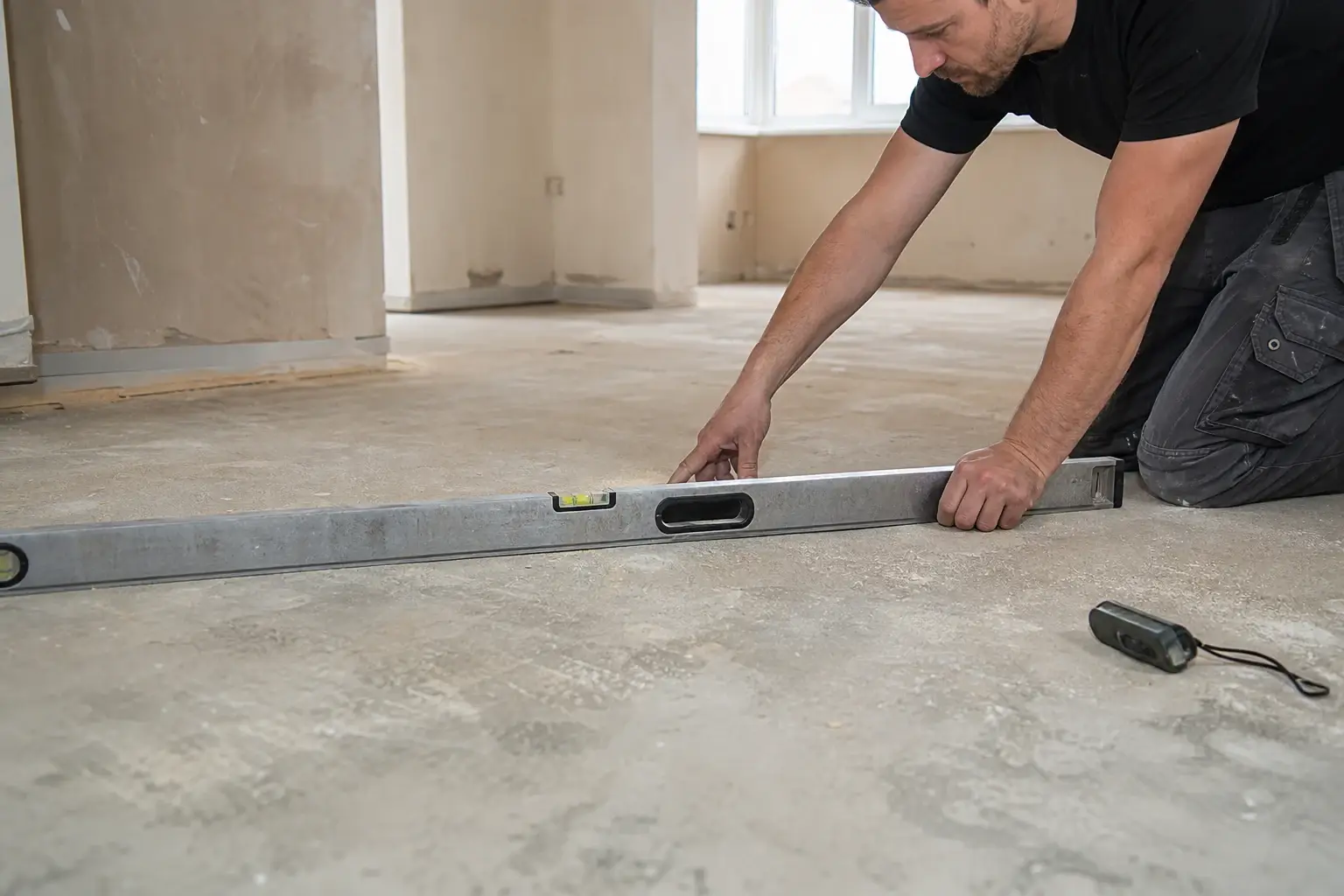
Subfloor flatness matters because the finished floor can only perform as intended if the surface beneath it is suitably prepared. If the base is uneven, out of tolerance or locally damaged, the flooring above may show visible defects, movement, poor fit or premature wear. In some cases the issue is obvious. In others, the floor may look acceptable at first but later develop problems that trace back to the substrate.
That does not mean every imperfection is a failure. Different floor coverings have different tolerances, and some local variation is normal in real buildings. The key question is whether the subfloor is flat enough for the flooring system being installed. That is a technical issue, and visual checks alone are rarely enough to answer it properly.
What flatness means in practice
Flatness is not the same as level. A floor can be out of level and still be flat enough for many floor finishes. What matters is whether there are dips, humps, ridges, cracks, laitance, screed ridging or other changes in surface profile that could affect the flooring above.
For example, a long straight edge may reveal a gentle hollow that is hard to see on its own but enough to create issues once a rigid or fixed flooring is installed. Equally, a small local ridge can telegraph through a thin finish, affect bonding, or create a step that becomes noticeable underfoot.
Why flatness affects different flooring types
Different coverings respond differently to subfloor defects:
- Rigid floors such as laminate, engineered wood and some floating systems may bridge over high spots, leaving voids beneath. That can contribute to movement, hollow sound, joint stress or localised failure.
- Bonded floors may not adhere properly if the substrate is uneven, dusty, weak, contaminated or friable as well as out of flat.
- Sheet and resilient floors can show visible imperfections more readily, with ridges, trowel marks or hollows sometimes telegraphing through the surface.
- Carpets may tolerate some variation, but poor preparation can still contribute to visible undulations, premature wear, seam stress or an unsatisfactory finish.
Flatness is also linked to other substrate conditions. A floor can be reasonably flat and still be unsuitable if it is too damp, poorly prepared, cracked, weak or incompatible with the chosen system. For that reason, flatness should be considered as part of a wider subfloor assessment rather than in isolation.
Related reading: why flooring can sound hollow or feel loose after installation.
Signs the subfloor may not be suitable
Some symptoms can suggest a flatness issue, although they do not prove it on their own:
- noticeable rocking, bounce or unevenness underfoot
- hollows, soft spots or areas that sound different when walked on
- visible ridges, dips or waviness in the finished floor
- gaps opening at joints or edges in certain areas
- localised lifting, debonding or edge movement
- a floor that feels acceptable in one area but unstable in another
These signs can also arise from other causes, including moisture movement, inadequate adhesive, poor fixing, substrate cracking or installation errors. That is why a proper inspection matters. The visible symptom is only the starting point.
If flooring has already started to move or sound abnormal, evidence should be gathered before the problem changes. This guide explains what is useful to keep: what evidence to gather before asking for an independent flooring inspection.
Why visual checks are not enough
A subfloor can appear acceptable to the eye while still having localised irregularities that affect performance. Conversely, some visually rough surfaces may still be acceptable once measured and assessed properly for the chosen flooring system.
That is why inspection usually involves more than a quick look. A meaningful assessment may include checking surface profile, straightness, changes in level, signs of cracking, substrate construction, moisture-related issues and the condition of any levelling or smoothing compounds. In some cases, the floor build-up and installation method are just as important as the subfloor itself.
Where relevant, moisture readings may also need to be considered, because dampness can affect bonds, finishes and movement as well as the appearance of the floor. If moisture-related defects are suspected, this article may help explain why problems can appear after fitting: why moisture problems can show up after a new floor is installed.
When an independent inspection can help
An independent subfloor inspection can be useful when the cause of a flooring problem is disputed, unclear or not being resolved. It can help establish whether the substrate was suitably prepared, whether flatness may have contributed to the failure, and whether other factors such as moisture, cracking or installation quality also played a part.
This is particularly relevant before further remedial work is carried out. Once flooring has been lifted, repaired or reinstalled, important evidence can be lost. An impartial inspection can provide a clearer technical picture and, where appropriate, a formal written report.
If you are unsure whether your situation needs a complaint, an inspection or both, this guide may help: how to tell whether a flooring problem needs an independent inspection or just a complaint.
The Flooring Inspector provides independent subfloor inspections across England, Scotland and Wales, with evidence-based findings that focus on the likely technical causes rather than assumptions. If a subfloor issue is suspected, a call-back request can be a sensible first step before any quotation for inspection is prepared.