
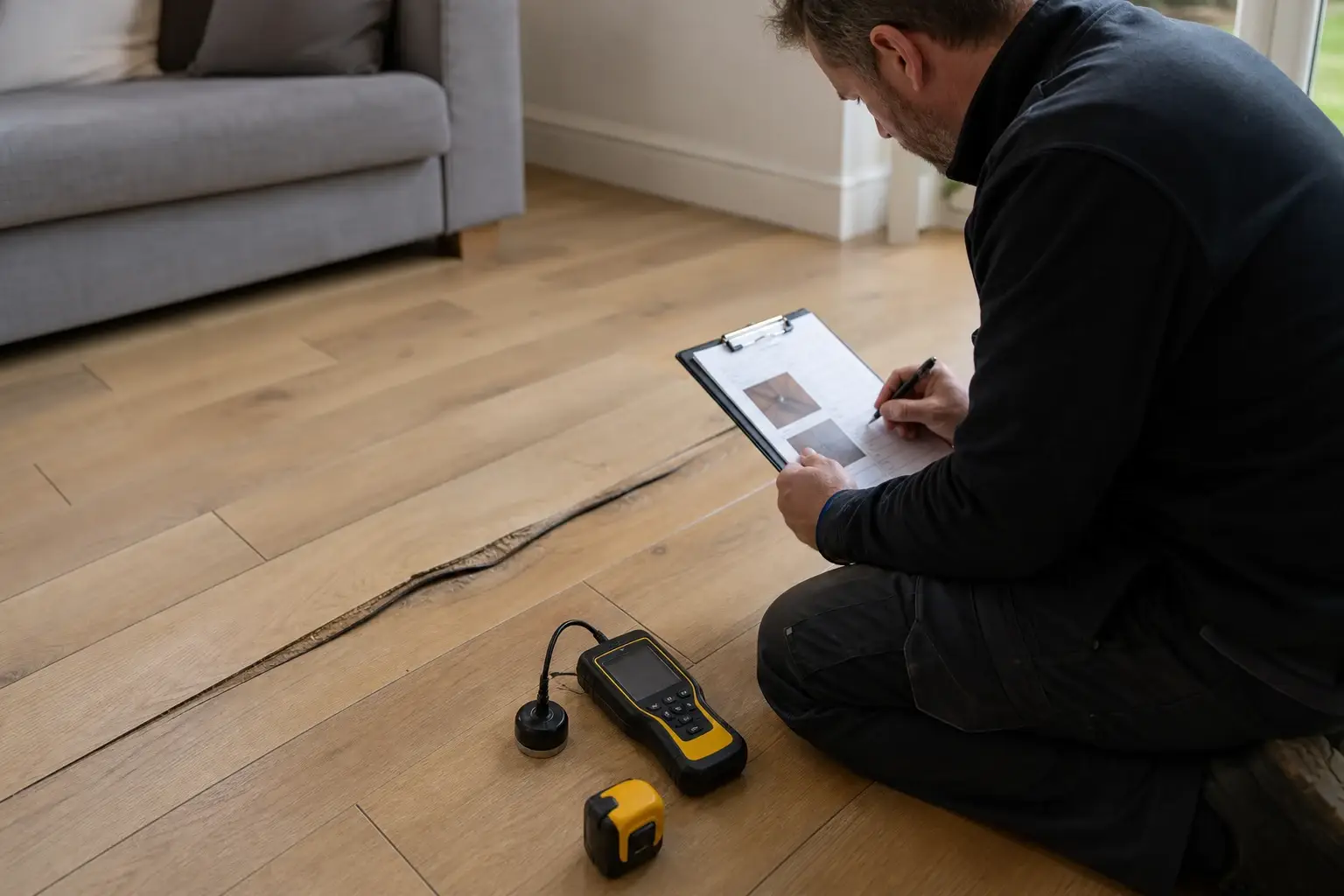
In a flooring dispute, the most useful report is rarely the one with the strongest opinion. It is the one that clearly separates what was observed, what may be causing the issue, and what further action is reasonable.
A flooring inspection report is meant to do exactly that. It should help everyone involved understand the same problem in the same terms, even if they do not agree on the cause or responsibility. That is why the wording matters so much. A carefully written report does not simply say a floor has failed. It explains what was seen, how it was assessed, and how strong the evidence is for any conclusion.
Start with the observations, not the opinion
The first part of a report usually deals with site observations. These are the facts recorded during the inspection, such as visible damage, movement, gaps, lifting, rippling, staining, odour, surface irregularities or signs of subfloor issues. In a well-structured report, these observations come before any interpretation.
That matters because different parties may look at the same floor and reach different conclusions. A homeowner may see a defective floor. An installer may point to building conditions. A retailer may question maintenance. The report should not take sides at this stage. It should describe the condition of the flooring as accurately as possible.
If the report refers to measurements, photographs or moisture readings, check whether they are linked to the relevant observation. In other words, the evidence should support the statement rather than sit beside it as decoration.
Separate “possible cause” from “confirmed cause”
This is one of the most important distinctions in any flooring dispute. A good report will usually distinguish between:
- Observed facts – what was actually seen, measured or tested
- Probable causes – the most likely explanation based on the evidence available
- Alternative causes – other factors that could also produce similar symptoms
- Recommendations – practical next steps to confirm, repair or manage the issue
If a report says a problem may be related to moisture, substrate preparation, adhesive failure, movement or an installation issue, that is not necessarily a weakness. It often reflects professional caution. Flooring defects can look similar on the surface while having very different underlying causes.
By contrast, if a report states a definite cause without showing how that conclusion was reached, it is worth reading carefully. The strength of the conclusion should match the quality of the evidence.
Look closely at the wording used in the findings
Report wording can be telling. Phrases such as “consistent with”, “indicative of” and “the evidence suggests” usually mean the inspector is describing a reasoned view based on the findings, rather than claiming certainty. That is normal in impartial technical reporting.
On the other hand, broad claims without explanation can be less helpful in a dispute. If the report uses technical terms, it should explain them in plain English. For example, terms like telegraphing, cupping, delamination or subfloor contamination may be relevant, but they should be tied to what was actually observed and why it matters.
If you are unsure about wording, read each section separately. Ask yourself:
- What was seen?
- What test or check supports that?
- What conclusion is being drawn?
- Is the conclusion definite, or qualified?
Recommendations are often as important as findings
In a dispute, recommendations can be just as valuable as the diagnosis. A report may suggest drying out a subfloor, carrying out further moisture testing, checking flatness, reviewing expansion gaps, or making targeted repairs. These recommendations help show whether the issue appears isolated, recurring or linked to a wider installation or substrate problem.
Sometimes the report will also say what it cannot establish. That is useful too. A report that acknowledges limits is usually more reliable than one that overreaches.
If the matter is heading towards a formal dispute, legal process or claim, the report may need to be read more carefully for structure and evidential value. In those situations, impartial wording and a clear audit trail of observations can matter as much as the technical conclusion. Where appropriate, a formal or CPR Part 35 compliant report may be required, depending on the circumstances of the case.
Why the independence of the report matters
An inspection report is most useful when it is independent from the parties involved in the flooring work. That is because disputes often hinge on interpretation rather than appearance alone. A floor may look obviously wrong, but the underlying cause could be installation-related, moisture-related, product-related, substrate-related or a combination of factors.
An impartial inspection aims to reduce that uncertainty. It gives all parties a common reference point and makes later discussions more focused. That can be especially helpful when a complaint has stalled and everyone is relying on assumptions.
If you are trying to make sense of a disputed flooring issue, related guides on disputed flooring installation checks and what evidence to gather before asking for an independent flooring inspection may also help. For general support with independent inspections and reports, see the Inspection Services page or the Contact page if you would like to request a call back before a quotation is prepared.
Ultimately, the best way to read a flooring inspection report is to follow the evidence in order: observations, testing, interpretation, then recommendations. If the report does that clearly, it is doing its job well – even if the answer is not the one any party hoped for.