
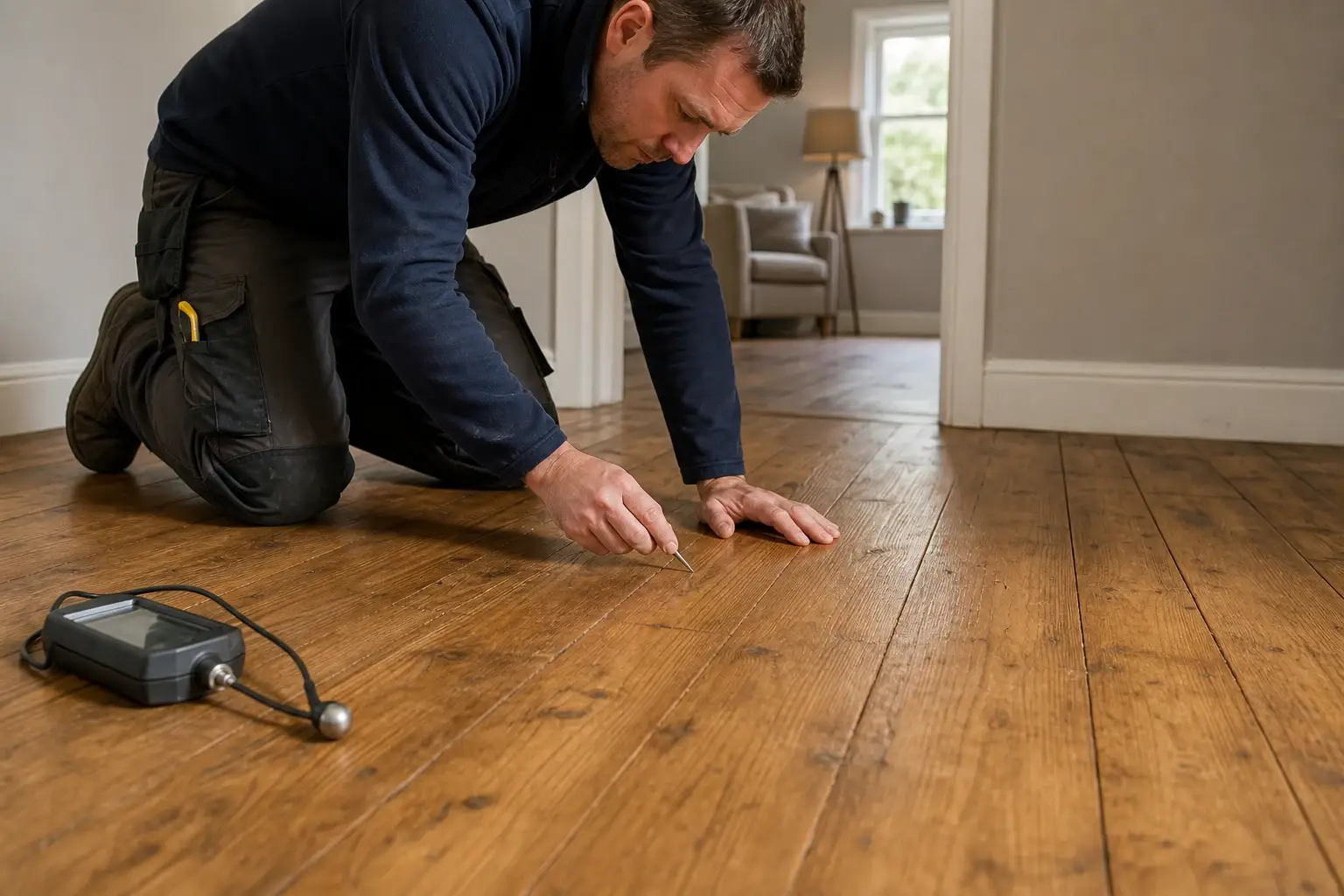
A wood floor squeaking is not always a sign of serious failure, but it is often telling you that something in the floor build-up is moving when it should not. The noise may come from timber rubbing against timber, fixings working loose, gaps opening and closing, or movement in the subfloor beneath.
The important point is that squeaks, bounce and visible movement do not all mean the same thing. A floor that only creaks in one small area may be irritating but stable. A floor that feels soft, lifts at the edges, or has started to move more noticeably can point to a wider issue that needs checking.
What can cause timber floors to squeak or move?
There are several possible reasons, and more than one can be present at the same time. An inspection is often needed before anyone can say which is most likely.
- Friction between boards – timber expands and contracts with changes in moisture and temperature. If boards rub against each other, squeaking can result.
- Movement at fixings – nails, screws or adhesives that are not performing as intended may allow the floor to shift slightly under load.
- Subfloor movement – joists, chipboard, plywood or another substrate beneath the visible floor may flex, settle or have localised defects.
- Inadequate expansion allowance – if the floor has not been given enough room to move, it may start to push, rub or stress adjoining areas. Why flooring can fail when expansion gaps are too small
- Moisture-related movement – timber can swell or shrink as moisture conditions change. That movement can sometimes create noise or a sense of looseness.
- Poor substrate preparation – if the base was uneven, contaminated or not suitable for the flooring system, the finished floor may not sit securely.
Sometimes the issue is simple wear. In other cases, the symptoms may suggest a defect in installation, subfloor preparation or environmental conditions. The sound itself does not identify the cause.
When squeaking is mostly a nuisance
Some timber floors squeak because of localised friction, seasonal movement or age-related settling. If the floor otherwise feels firm, stays level and the noise is confined to one or two boards, it may be more of an annoyance than a structural concern.
That said, a nuisance squeak can still be worth documenting. If it is new, getting worse, or appearing after recent installation, renovation or changes in heating or humidity, it may be useful evidence if the issue is later disputed.
When movement may point to a problem
More concern is usually warranted if the floor feels bouncy, depresses underfoot, or has visible signs such as lifting edges, gapping, ridging or unevenness. A timber floor that moves noticeably can indicate that the floor covering, the substrate, or both are not performing as intended.
Pay particular attention if you notice:
- a springy or hollow feel underfoot
- areas that squeak in several spots rather than one isolated location
- looseness near joins, doorways or perimeter edges
- new movement after a leak, condensation event or change in heating
- cracks, gaps or other changes alongside the squeak
Those symptoms do not prove a specific failure, but they do suggest that a closer investigation may be needed.
How an inspection can help
An independent flooring inspection looks at the symptoms in context: the floor type, the subfloor, the fixing method, moisture conditions and the pattern of movement. That matters because a squeak at a stair nosing, a board end, or over a joist line may have a very different cause from a general bounce across a room.
Depending on the floor and the complaint, an inspection may include visual checks, moisture testing, assessment of the substrate and review of the installation details. The aim is to identify the underlying cause where possible, rather than guess from the sound alone.
If the problem is part of a wider dispute, a formal written report can provide clear evidence-based findings. The Flooring Inspector works independently from manufacturers, suppliers and installers, which helps keep the assessment impartial.
If you are trying to work out whether the issue is simply irritating or potentially defective, How to tell whether a flooring problem needs an independent inspection or just a complaint may help. For floors that are also showing edge lift, Why timber floors can lift at the edges, and what it may indicate is also relevant.
If you are dealing with an unresolved timber floor problem and need an impartial view, you can request a call back through the Flooring Inspector website before a quotation for inspection is prepared.