
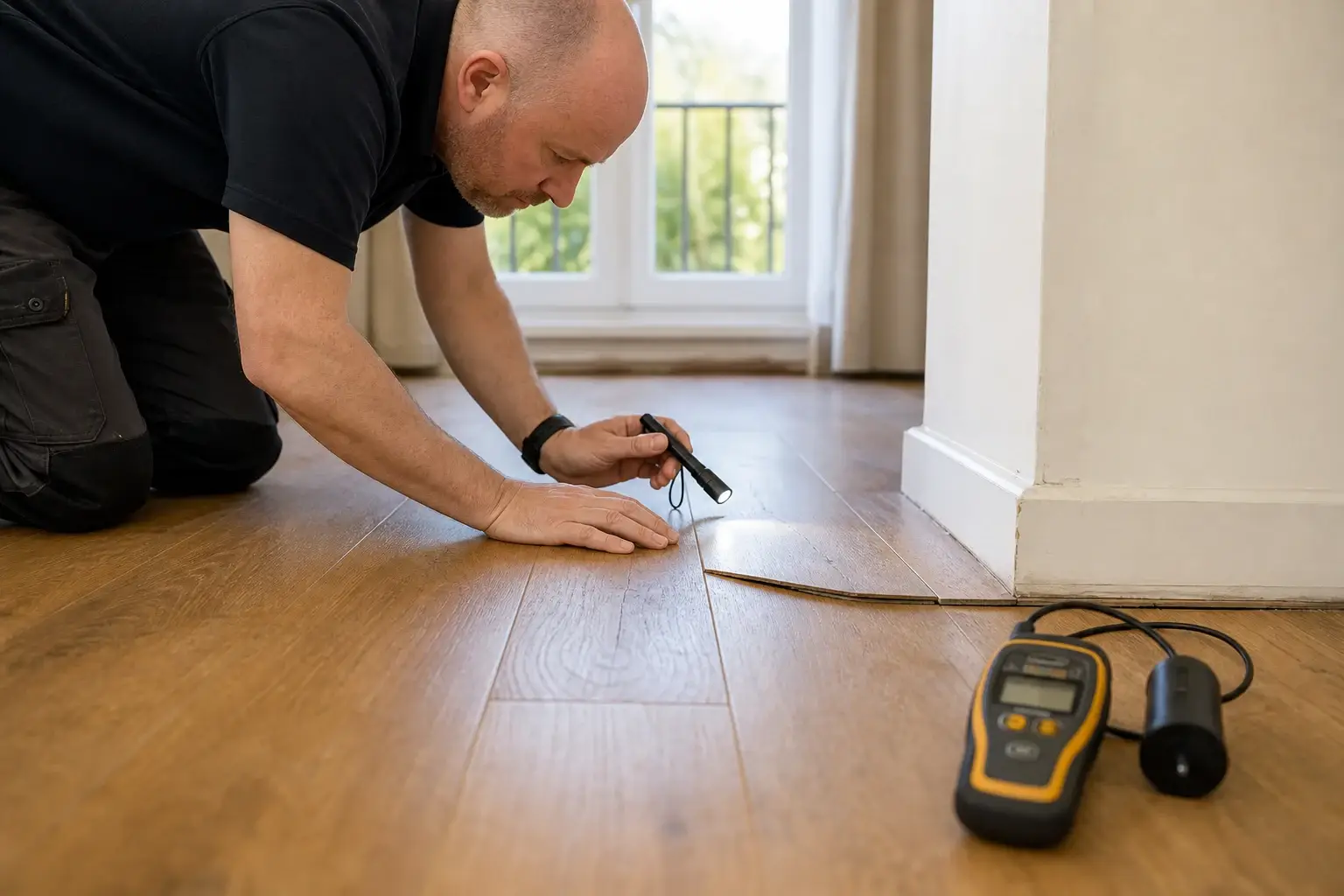
When a timber floor starts lifting at the edges, the visible symptom is easy to spot but the cause is not. Raised board edges, slight curling or a lip appearing along one side can be linked to moisture movement, installation issues, subfloor conditions or a combination of factors. In practice, similar-looking symptoms can come from very different problems.
That is why edge lift should be treated as a sign that the floor is under stress, not as proof of a single defect. The right next step is to look at what else is happening around the floor, the room and the substrate beneath it.
What edge lift can look like
Timber floor lifting at the edges may appear in a few ways:
- board edges sitting higher than the centre of the plank
- slight curling along one side of a board or several boards
- a raised line running across part of the floor
- noticeable movement near walls, doorways or damp-prone areas
On engineered wood, this may be confined to the surface layer or board profile. On solid timber, the movement can be more pronounced because the material responds directly to changes in moisture and environment. Either way, the visible shape can help narrow down the likely cause, but it does not establish it on its own.
Common reasons a timber floor may lift at the edges
One of the most common contributors is moisture change. Timber expands and contracts as conditions change, and if a floor takes on excess moisture, it can swell and begin to distort. In some cases this may be related to condensation, leaks, spillages, rising damp or a damp subfloor. If you are already concerned about moisture, it may help to read more about why moisture readings matter before new flooring is installed.
Another possible factor is inadequate movement allowance. Timber floors normally need enough space to expand. If boards have been installed too tightly, or fixed in a way that restricts natural movement, the pressure may show up as edge lift, peaking or other visible distortion.
Subfloor problems can also play a part. A substrate that is uneven, insufficiently dry, contaminated or not suitable for the flooring system can create stress in the finished floor. This is particularly relevant where the timber has been installed over concrete, screed or a timber subfloor that has not been properly prepared. A focused subfloor inspection can help identify whether the problem starts below the flooring rather than in the boards themselves.
Installation quality matters too. Incorrect adhesive choice, poor fixing methods, poor acclimatisation, rushed fitting or failure to follow the manufacturer’s instructions can all contribute to visible movement later on. In a disputed installation, it is usually important to separate what the floor is doing now from what may have happened at the time it was fitted.
Environmental conditions can also influence the outcome. Rooms with underfloor heating, large seasonal swings, poor ventilation or localised moisture sources may behave differently from the rest of the property. If underfloor heating is involved, the floor system and the conditions beneath it need to be assessed as a whole, as explained in this guide to underfloor heating and flooring.
Why the same symptom can have different causes
Edge lift is not a diagnosis. A floor that appears to be curling because it is damp may also have poor expansion gaps. A floor that looks like an installation fault may actually be reacting to seasonal humidity or a concealed substrate issue. That is why experience alone is not enough to reach a reliable conclusion without checking the floor in context.
An independent flooring inspection can look at the visible symptoms, take relevant moisture readings where appropriate, assess the substrate and review the installation details to identify the most likely underlying cause. That is especially useful where there is a complaint, a dispute or uncertainty about who should address the problem.
What to do if you notice edge lift
If a timber floor is starting to lift at the edges, it is sensible to avoid assuming it will settle on its own. Small changes can become more obvious if moisture or movement continues.
Practical next steps include:
- make a note of when the issue first appeared
- check whether the problem is localised or affecting several areas
- look for signs of moisture, staining, leaks or condensation nearby
- keep a record of any recent works, cleaning, heating changes or weather-related changes in the property
- avoid carrying out remedial work before the cause is understood, especially if the floor is part of a complaint or dispute
If the floor is new, if the movement is getting worse, or if there is disagreement about responsibility, an impartial assessment is often the most sensible way forward. The Flooring Inspector provides independent inspections and reports across England, Scotland and Wales, including wood and timber floor investigations, moisture-related assessments and formal written reports where required.
If you need help with timber floor lifting at the edges, a member of the team can discuss the issue before a quotation for inspection is prepared. You can request a call back if the problem is unresolved and you would like the next step explained clearly.