
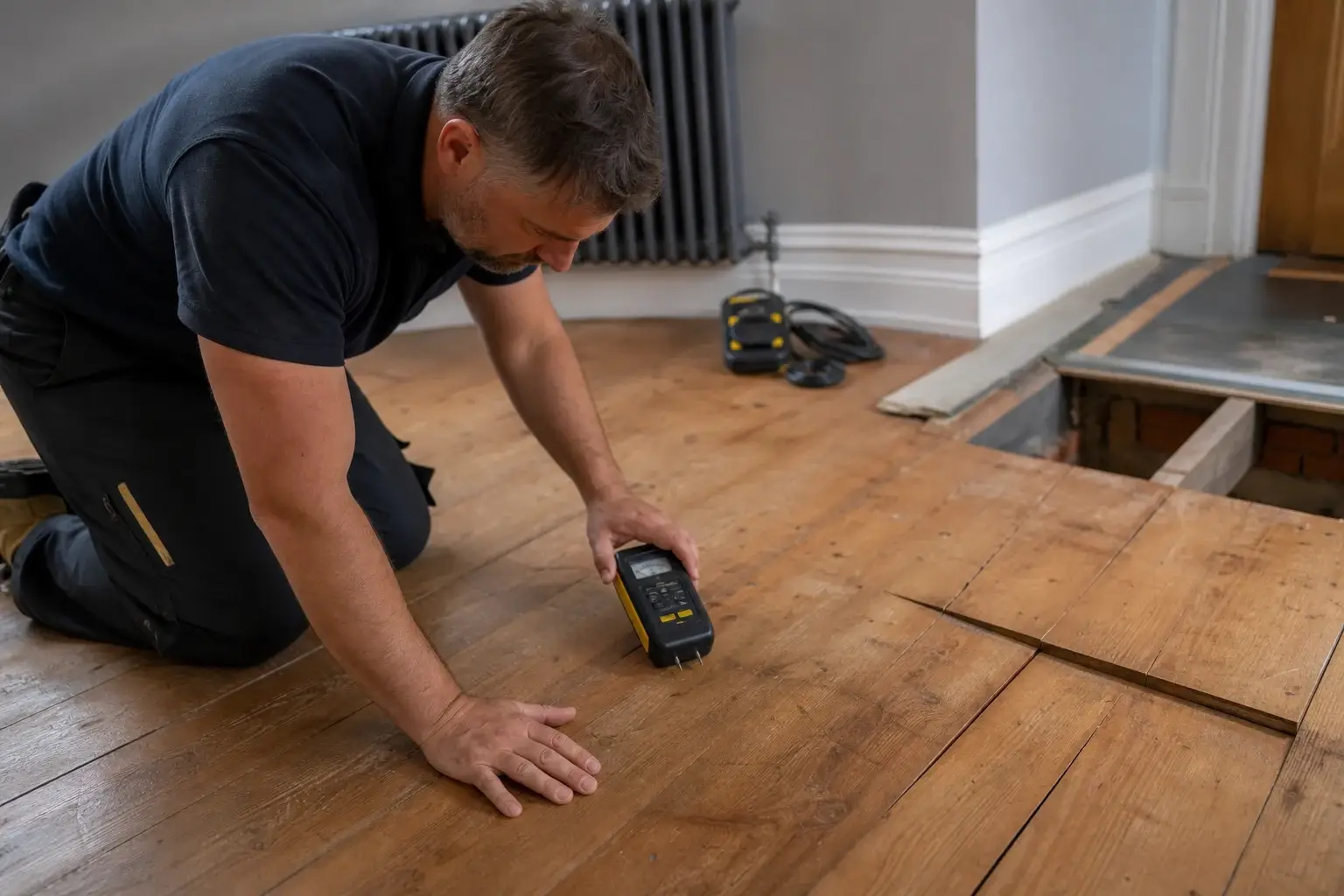
A timber floor that feels loose, bouncy or springy underfoot does not automatically mean it has failed, but it does suggest that something may not be performing as intended. The cause could lie in the boards themselves, the fixings, the joists or the subfloor below.
In practice, that “not quite right” feeling often appears before a clearer defect develops. A board may dip slightly when walked on, one area may feel more flexible than the rest, or the floor may give a soft movement that was not there before. Those signs are worth taking seriously, especially if the change is new or getting worse.
What a springy timber floor may be telling you
Timber floorboards should normally feel stable underfoot. Some slight movement can be part of the natural character of older floors, particularly where the structure is timber framed, but noticeable bounce, creaking or looseness can point to a problem that deserves inspection.
The symptom itself does not tell you the exact cause. A floor that feels loose or springy could be affected by:
- insufficient or failed fixings
- movement in the boards, battens or joists
- a weakened or uneven subfloor
- gaps between the boards and the support below
- previous repairs or alterations that have not held properly
- moisture-related movement in the timber or surrounding structure
That is why it is better to treat the underfoot feel as a clue, not a conclusion. An independent inspection can help separate normal timber behaviour from a defect or support issue.
Visible signs that often accompany the movement
If timber floorboards feel loose or springy, there are often other signs nearby. These may include:
- creaking or knocking when walked on
- small gaps opening between boards
- boards rocking slightly at the edges
- areas that sound hollow when tapped
- localised dips, ridges or unevenness
- nails or fixings lifting or becoming visible
- movement that is worse in one room or one part of the floor
None of these signs proves the cause on its own. For example, a creak can come from friction between timber elements, while a hollow sound may indicate poor contact with the support below. The pattern of symptoms matters as much as the symptom itself.
If the issue appears at the perimeter of the floor, it can overlap with edge movement or lifting. In timber floors, edge-related problems can arise for several different reasons, so it can be helpful to look at the whole floor system rather than focusing on one board or one visible defect. Edge lifting in timber floors: signs, likely causes and next steps explains this in more detail.
Possible causes beneath the surface
When a timber floor feels loose or springy, the underlying issue may be in the structure below rather than the boards themselves. Common possibilities include a problem with the joists, fixing points or the condition of the subfloor. In other cases, a floor may have been installed without enough support, or with fixings that have not held as intended.
Moisture can also play a part. Timber responds to changes in environmental conditions, and if there has been damp, condensation or poor ventilation, the floor may move, swell or shrink in ways that affect how it feels underfoot. That does not mean moisture is always the cause, only that it is one of the factors worth checking.
Where there has been recent work elsewhere in the property, structural movement, repairs or changes to the substrate can also influence the floor. An experienced inspector will usually look at the floor as part of a wider system: the board construction, the fixing method, the support below and the surrounding conditions.
For timber floors specifically, it is also important to distinguish between a visible movement issue and a noise issue. Squeaks and bounce can occur together, but not always for the same reason. Why timber floorboards squeak or move, and when it may be a problem covers the relationship between movement and noise.
What to check before asking for an inspection
If the floor is still in dispute or you are not sure whether the problem is getting worse, it helps to record what you are seeing rather than trying to test or alter it yourself.
- Note exactly where the movement feels worst.
- Record whether it happens only when stepped on or is present at rest.
- Take clear photos or short videos of any visible movement, gaps or damage.
- Keep a note of when the issue first appeared and whether it is changing.
- Retain installation details, invoices and any correspondence if the matter is disputed.
If you are gathering evidence for a complaint or dispute, this can help create a clearer picture of what has changed and when. What evidence to gather before asking for an independent flooring inspection sets out the type of information that is often useful.
When an independent inspection is the sensible next step
If timber floorboards continue to feel loose or springy, or the cause is not obvious, an independent flooring inspection can help determine what is actually happening. That may involve assessing the visible condition, checking patterns of movement, considering the fixing method and looking at the subfloor or supporting structure where appropriate.
This is especially useful where there is disagreement about responsibility, where previous repairs have not solved the issue, or where the floor is part of a wider building defect investigation. The aim is not to assume blame, but to identify the most likely underlying cause based on evidence.
The Flooring Inspector provides independent timber floor inspections across England, Scotland and Wales, with formal written reports available where needed, including reports for disputes or legal matters where appropriate. If you are dealing with an unresolved timber floor problem, a call back can be arranged before any quotation for inspection is prepared.
For a broader overview of timber flooring inspections, see Wood Floor Inspector.