
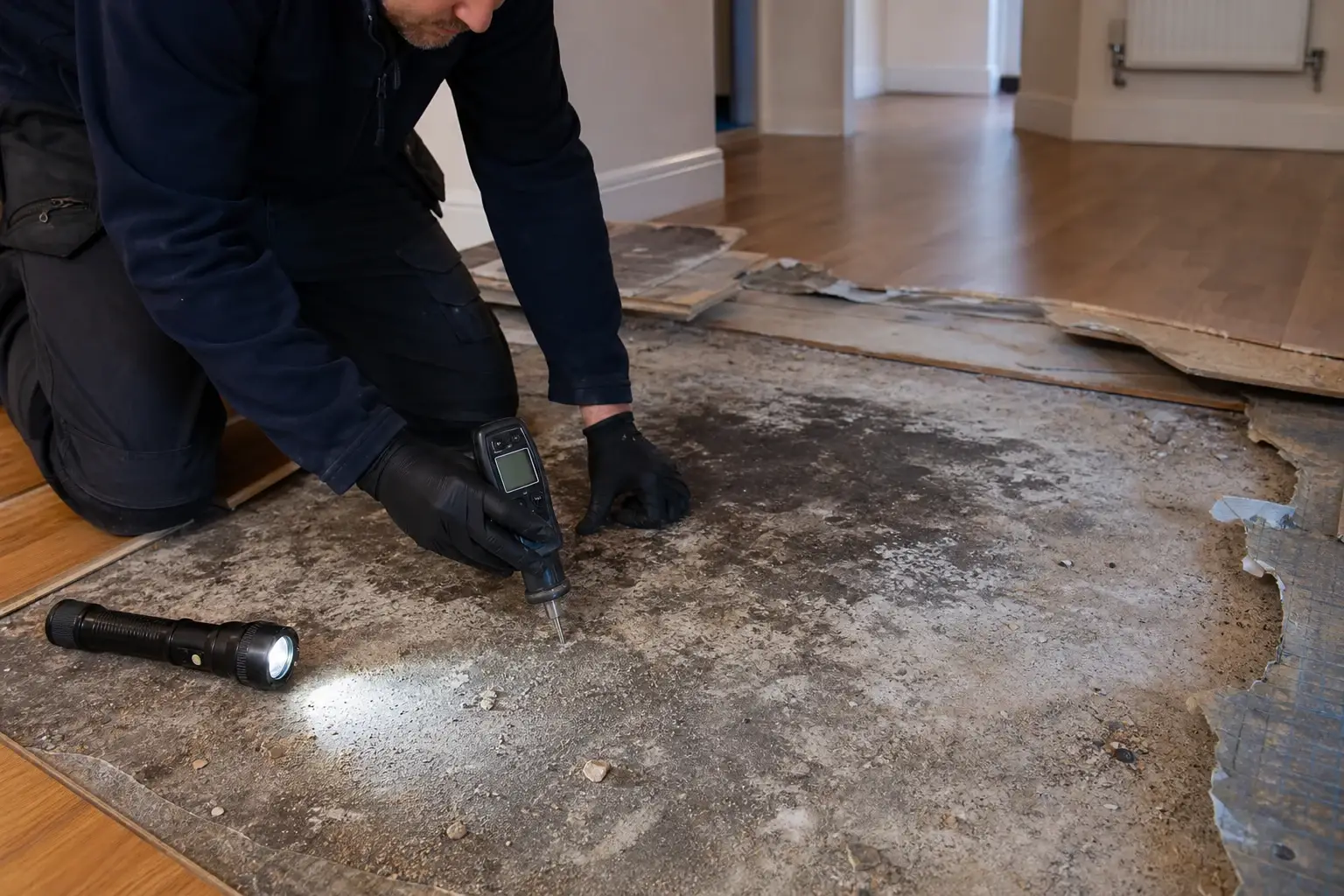
Subfloor contamination is one of those hidden problems that can be easy to overlook until a floor starts lifting, sounding hollow or showing visible signs of distress. In plain terms, it means there is something on or within the subfloor that should not be there, and that contamination is interfering with how the flooring system performs.
The difficulty is that the visible symptoms are often not specific. Loose edges, poor adhesion, bubbling, telegraphing or uneven appearance may be linked to contamination, but they can also arise from moisture, inadequate preparation, unsuitable adhesive, poor flatness or installation errors. That is why surface observation alone is rarely enough to identify the underlying cause.
What counts as subfloor contamination?
Contamination can take several forms depending on the substrate and the work that has taken place before the floor was installed. Common examples include dust, plaster, paint, adhesive residue, oil, grease, laitance on new concrete, old levelling compound that has not bonded properly, and other debris left behind during preparation or building work.
Sometimes the contamination is obvious. You may be able to see a dusty film, patches of residue or a weak, friable surface layer. In other cases, it is less visible and may only become apparent when a floor begins to fail or an inspection tests the condition of the subfloor more closely.
Warning signs that can point to contamination
The symptoms below do not prove contamination on their own, but they can be clues that the subfloor deserves closer investigation:
- Lifting or debonding – flooring may start to lift at edges, seams or isolated patches if the adhesive cannot bond properly to the substrate.
- Hollow or drummy areas – a hollow sound underfoot can indicate poor adhesion or voids between the floor and subfloor.
- Telegraphing – imperfections or residues beneath the floor can sometimes show through as ridges, marks or surface irregularities.
- Bubbling, blisters or soft spots – these can appear where adhesion has broken down or where localised contamination has affected the bond.
- Uneven wear or premature movement – if the floor is not supported consistently, it may move, flex or wear unevenly.
These signs are especially important where the failure appears in isolated areas rather than across the whole floor. Localised symptoms can suggest a localised issue with preparation, contamination or bonding.
Why contamination affects flooring performance
Most flooring systems rely on clean, sound and suitably prepared substrates. If the subfloor is contaminated, the adhesive may not wet out correctly, bond may be reduced, or the floor may not sit as intended. On some projects, contamination can also affect the way levelling compounds or primers perform, which then creates a problem for the finished floor above.
That matters because the flooring product itself may be perfectly suitable, but still fail to perform if the substrate beneath it was not ready. Equally, a floor that looks defective from above may actually be reacting to a subfloor condition that is no longer visible once the flooring has been installed.
If you are investigating a new floor, it can be helpful to consider related issues such as moisture testing before flooring goes down and why subfloor flatness matters before flooring is installed, because contamination often sits alongside other preparation problems rather than acting alone.
Why visual checks alone are often not enough
A floor can look clean on the surface and still have a contaminated or compromised substrate beneath. Likewise, visible dust or residue does not automatically mean it is the main cause of a failure. The same symptom can be produced by different faults, which is why assumptions can be misleading.
An independent inspection can help separate what is visible from what is actually driving the problem. Depending on the circumstances, that may involve a close visual survey, checking the flooring construction, reviewing installation conditions, assessing moisture-related factors and examining the subfloor where access is possible.
That evidence-led approach is particularly important in a dispute, where each party may be relying on limited observations. A clear inspection record can help distinguish contamination from other possible causes such as adhesive failure, substrate incompatibility or moisture movement.
What to do if you suspect a contaminated subfloor
If a floor has started to fail and contamination is one possible explanation, avoid treating the visible symptom as the whole story. It is usually better to preserve the affected areas, keep any installation paperwork if you have it, and document when the problem first appeared and how it has changed.
Where the issue is unresolved, an independent flooring inspection can help establish whether contamination is present, whether it is likely to have affected performance, and what other factors need to be considered before any remedial plan is agreed.
The Flooring Inspector carries out impartial flooring inspections across England, Scotland and Wales, with reporting for homeowners, contractors, insurers and legal professionals where appropriate. If you need help understanding a suspected flooring failure, request a call back and a member of the team can discuss the issue before a quotation for inspection is prepared.