
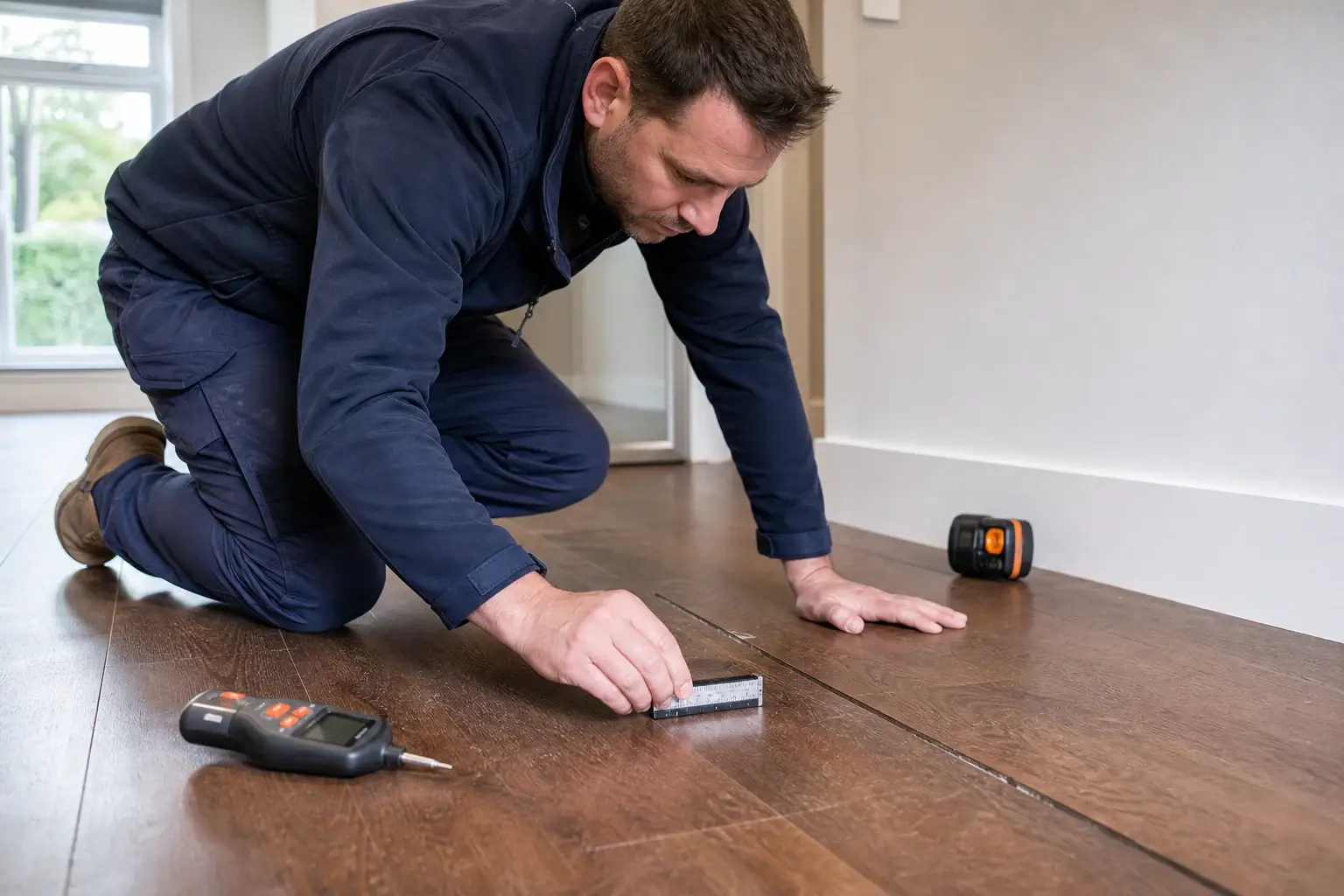
When a flooring problem becomes disputed, the surface appearance can be misleading. A gap, ripple, lifted edge or hollow sound may look straightforward, but the real cause could be cosmetic, installation-related or linked to a deeper issue in the subfloor or moisture conditions.
The most useful approach is to separate what can be seen from what still needs to be checked. That distinction matters because similar symptoms can arise from very different causes, and a proper disputed flooring installation needs evidence rather than assumptions.
Start with the visible symptom, but do not stop there
The first step is to note exactly what is happening and where it is happening. Is the issue localised to one doorway, one run of boards, a section of carpet seam or an entire room? Has it appeared suddenly or developed over time? Has it changed with temperature, heating use or damp weather?
These details help narrow down the possibilities, but they do not by themselves prove a defect. For example, an edge that appears to lift could be related to expansion, adhesion, moisture movement or localised subfloor irregularity. A ripple in carpet may be a fitting issue, but it could also reflect movement below or product behaviour. That is why the pattern of the problem matters as much as the problem itself.
Photographs are useful, especially if they show the issue from more than one angle and include context such as adjoining thresholds, skirting, radiators or visible joins. If the problem changes, dated images can help show progression.
Check the installation context before assuming fault
In a dispute, it is important to look at what was known at the time of installation. Was the flooring installed over a new or existing subfloor? Was there any levelling, priming or moisture testing beforehand? Were there known site conditions such as recent building work, underfloor heating, condensation, or a history of damp?
Supporting paperwork can be just as important as the floor itself. Invoices, product details, fitting instructions, moisture readings, handover notes and complaint correspondence may all help build the picture. Missing paperwork does not prove a problem, but it can make it harder to establish whether the installation was carried out in line with expectations.
Where the issue involves adhesive performance or contamination, it may also be relevant to consider whether the subfloor was properly prepared. Dust, residue or other contamination can interfere with adhesion and finish, which is why subfloor condition is often central to a dispute. You can read more about subfloor contamination and flooring failure and adhesive failure in flooring.
Ask whether the symptom could have more than one explanation
Many flooring problems have overlapping symptoms. That is one reason disputes can become difficult quickly. A floor that sounds hollow may be affected by poor adhesion, but it may also reflect the way the substrate was constructed. Gaps in timber flooring may relate to seasonal movement, but they can also be influenced by installation tolerances, moisture imbalance or environmental conditions. Uneven carpet appearance might be caused by fitting, but it may also reveal subfloor irregularity or the behaviour of the backing and underlay.
This is where careful, impartial observation helps. A visible defect should be assessed alongside the surrounding details: transitions, edges, joints, movement underfoot, signs of compression, pattern repeat, visible moisture staining, odour, or changes near external walls and wet areas. One symptom rarely tells the full story on its own.
Moisture and subfloor condition are often central
In many disputes, the key question is not simply whether the floor looks wrong, but whether the supporting structure was suitable when the flooring was installed and whether conditions later changed. Moisture can affect timber, carpet underlays, adhesives, screeds and many finished floor types. It can also contribute to distortion, lifting, bubbling, cupping, odour or loss of bond.
If there is any suggestion of moisture-related movement or failure, a proper inspection may include moisture testing and subfloor assessment. That can help determine whether the issue is linked to the floor covering itself, the substrate below it, or the conditions in the property. If you are trying to understand this area further, our guide on moisture damage in flooring may be useful.
It is also worth considering whether the floor has been asked to perform in conditions it was not designed for, such as excessive moisture, poor ventilation or inappropriate use over underfloor heating. Where relevant, the broader installation context can be just as important as the visible damage.
Know the limits of visual checks
Some issues can be identified visually, but many cannot be resolved from appearance alone. A homeowner, contractor or retailer may reasonably spot that something is wrong, but it is usually not possible to say with confidence exactly why it has happened without investigation.
That is especially true where a dispute already exists. Once views have hardened, each party may focus on different parts of the evidence. An independent inspection can help reset the discussion by looking at the problem on technical grounds and setting out findings in a clear, impartial way.
Where appropriate, the report may consider visible symptoms, installation details, subfloor condition, moisture-related findings and any relevant supporting documents. The aim is not to take sides, but to identify the most likely cause or causes based on the evidence available.
When an independent inspection is worth considering
An independent inspection is often sensible when the cause of a flooring problem is unclear, the issue is being disputed, or the evidence needs to be presented in a more structured way. It can also help where temporary fixes have failed, the floor has worsened over time, or different parties are offering conflicting explanations.
If you are dealing with an unresolved flooring dispute, you may find it helpful to request a call back so the issue can be discussed before a quotation for inspection is prepared. The Flooring Inspector works independently across England, Scotland and Wales and provides impartial inspections, reports and, where appropriate, formal technical reporting for dispute resolution.
For a fuller view of the evidence that can help before an inspection, see what evidence to gather before asking for an independent flooring inspection and how to tell whether a flooring problem needs an independent inspection or just a complaint.