
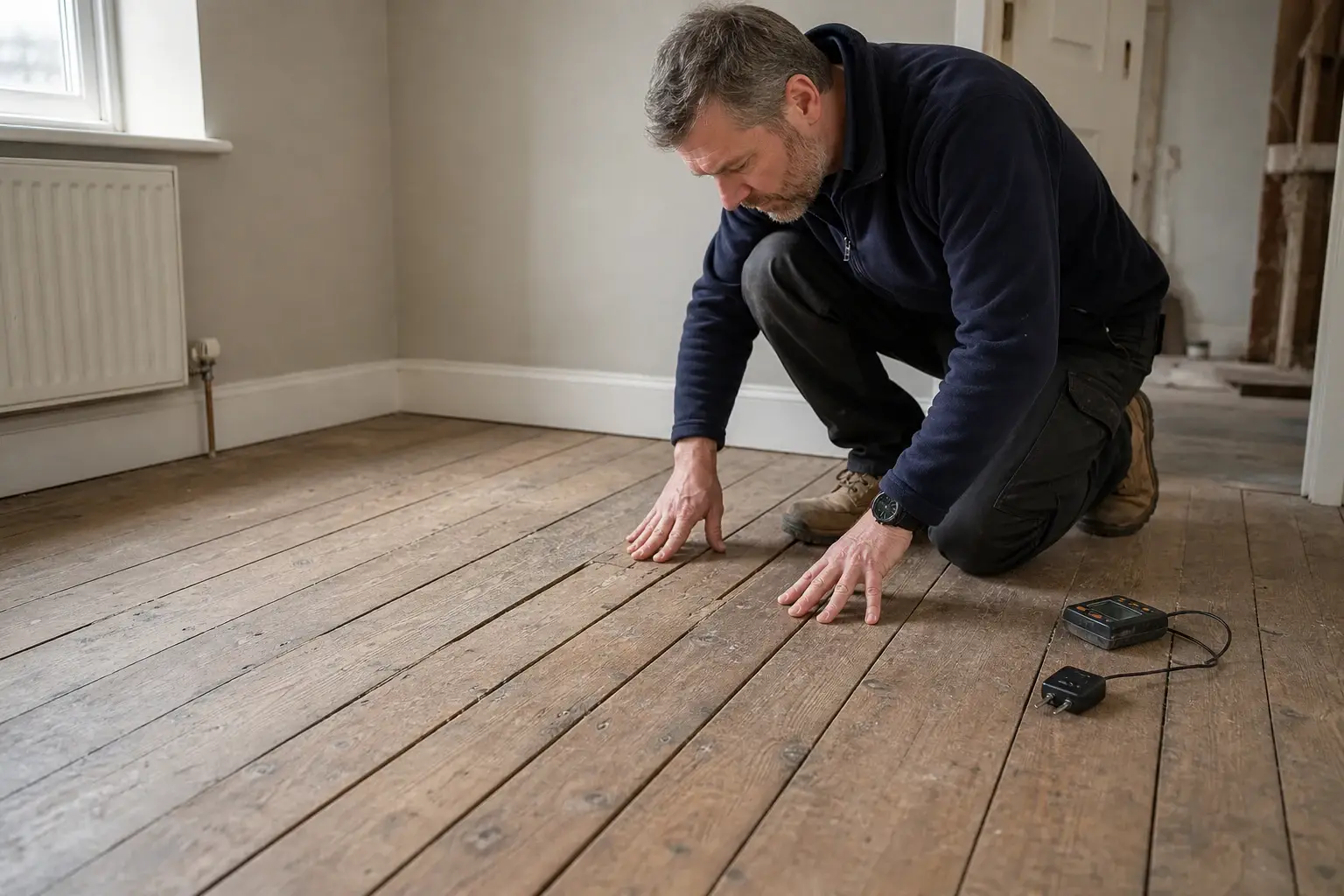
A timber floor that feels loose, springy or bouncy underfoot does not automatically mean it has failed. But it is usually telling you that something in the floor build-up is not behaving as it should. The movement may come from the boards themselves, the fixings, the subfloor, or the way the floor was installed.
That is the difficulty with this kind of problem: the same sensation can come from several different causes. A floor that feels insecure in one area may have a very different issue from one that squeaks, flexes or dips in another. An independent inspection can help separate normal timber movement from a defect that needs further action.
What “loose” or “springy” often means in practice
People describe these floors in different ways. The surface may feel slightly soft, may give underfoot, or may seem to move more than expected when walked on. In some cases there is visible deflection. In others, the floor only feels wrong because it is noisier or less solid than it used to be.
That feeling of movement can be confined to a single board, a small section, or a wider area. The pattern matters. Localised movement often suggests a problem with a particular fixing, joint or support point. Wider movement can point more towards subfloor flex, insufficient support, or a more general installation issue.
Common contributing factors
Several issues can lead to loose or springy timber floorboards, and more than one may be present at the same time:
- Insufficient or failed fixings – boards may not be properly secured to the joists or subfloor, or fixings may have loosened over time.
- Movement in the subfloor or joists – if the structure below flexes, the finish above can feel soft or unstable.
- Poor substrate preparation – irregular or uneven support can leave parts of the floor spanning where they should not.
- Moisture-related movement – timber can expand, contract or distort as conditions change, which may affect how secure the floor feels.
- Wear or deterioration of underlay or layers below the surface – where present, these layers can contribute to a changed feel underfoot.
- Installation defects – incorrect fixing methods, poor spacing, or inadequate allowance for movement can all affect performance.
None of those points should be assumed from appearance alone. A floor can look sound and still feel wrong when walked on. Equally, a visibly uneven floor is not always structurally defective. The symptom is useful, but it is only one part of the picture.
Why a visual check may not be enough
Flooring disputes often begin with what can be seen: a gap, a squeak, a board edge, or a slight rise in the surface. But timber flooring problems are frequently hidden below the finish. A visual check may confirm that a board moves, but it will not usually show whether the cause is a missing fixing, a subfloor irregularity, a support issue or environmental movement.
That is especially important if the floor has already been the subject of a complaint. Once a dispute starts, opinions based only on appearance can become unhelpful very quickly. What matters is evidence: where the movement is occurring, how widespread it is, whether the floor is consistent with the way it was installed, and whether the substrate conditions support the flooring type.
If you are trying to work out the next step, it can help to review the wider signs around the floor as well as the movement itself. Wood Floor Inspector explains the sort of issues typically considered during a timber floor assessment, while Timber floorboards that feel loose or springy underfoot is useful for understanding how these symptoms are approached in practice.
Clues that can help narrow the cause
Some details are often useful when an inspector is assessing a complaint:
- Whether the movement is constant or only happens in certain weather conditions
- Whether the issue is localised to one area or spread across the room
- Whether the floor also squeaks, creaks or sounds hollow
- Whether there is visible gapping, lifting, cupping or edge movement
- Whether the problem appeared soon after installation or developed later
- Whether there has been any recent change in heating, humidity or occupancy
These clues do not prove the cause on their own, but they can help distinguish between a likely fixing issue, subfloor movement, moisture-related change or a broader installation defect.
When an independent inspection becomes worthwhile
If the floor still feels insecure after a complaint has been raised, or if there is disagreement about whether the movement is acceptable, an independent inspection can provide a clearer basis for discussion. That is particularly relevant where a repair has already been attempted, where the problem is intermittent, or where the cause is not obvious from a quick look.
The Flooring Inspector provides impartial assessments of timber flooring problems across England, Scotland and Wales. The aim is not to jump to blame, but to identify the underlying cause where possible and set out practical findings in clear, evidence-based terms.
If you are dealing with loose or springy timber floorboards and need help understanding what may be going on, a call back can be arranged so the issue can be discussed before any quotation for inspection is prepared.