
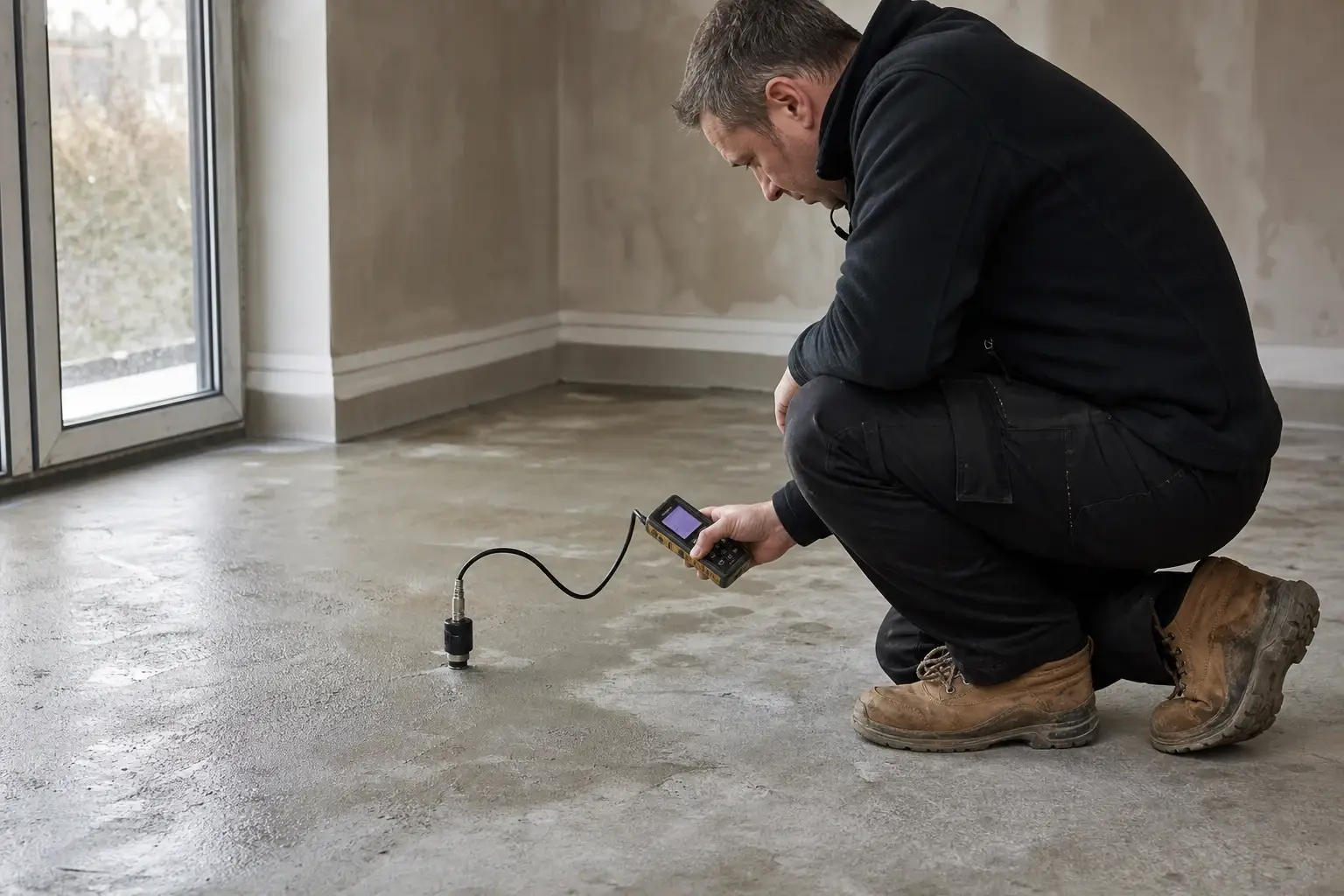
Moisture testing before flooring installation is one of the most important checks you can carry out before a new floor is fitted. A subfloor can look dry, clean and ready while still holding enough moisture to affect adhesive bond, cause movement, or trigger later problems with wood, LVT or other floor finishes.
That is why appearance alone is rarely enough. A visual check can spot obvious issues such as staining, cracking, contamination or surface damage, but it cannot confirm whether the subfloor is actually suitable for the flooring system being installed. Proper testing helps build a clearer picture before the floor goes down.
What moisture testing is trying to establish
The aim is not simply to find out whether a floor is “wet” or “dry” in everyday terms. The real question is whether the moisture condition of the subfloor is compatible with the chosen flooring, adhesive and installation method.
Depending on the floor build-up, the inspection may need to consider:
- the condition of the subfloor or screed
- whether moisture is still present in the structure
- whether the surface is suitable for the planned adhesive or flooring system
- whether site conditions could affect drying or performance after installation
If these checks are missed or rushed, flooring may appear satisfactory at first but later show signs such as lifting, bubbling, edge movement, hollow sounding areas, gapping, or adhesive breakdown.
Why visual assessment on its own can be misleading
Many moisture-related defects are not obvious from the surface. A concrete subfloor may look sound while still retaining moisture deeper within. Likewise, a timber substrate may seem stable even though its moisture condition is affected by the environment around it.
Visual signs can sometimes help an inspector decide where to look, but they do not tell the whole story. For example, staining or efflorescence may suggest a moisture issue, but absence of visible signs does not rule one out. That is why moisture testing is normally part of a wider assessment rather than a stand-alone answer.
Common checks that may be involved
The exact testing method depends on the floor, the substrate and the circumstances. In practice, a proper assessment may include a combination of observation and measurement rather than a single reading taken in isolation.
Common checks can include:
- inspection of the subfloor condition before floor covering is laid
- assessment of visible signs of damp, staining, cracking or contamination
- moisture testing of the substrate using appropriate methods for the material
- checking environmental conditions where relevant
- reviewing whether the floor system is suitable for the condition found
It is also important to interpret readings in context. A number on its own is not the same as a conclusion. What matters is what that reading means for the particular flooring system being considered.
What poor moisture control can lead to
Excess moisture does not affect every floor in the same way, but it can cause a range of problems. Wood flooring may respond by moving, cupping or lifting. LVT may lose bond, develop edge lift or show signs of telegraphing from the subfloor below. Carpets can also be affected if the subfloor condition interferes with the system or installation materials.
Sometimes the visible failure appears weeks or months after fitting, which can make the cause harder to trace. That delay does not automatically mean the installation was at fault or that the flooring product was unsuitable. It simply means the underlying conditions need to be investigated properly.
For a broader look at early warning signs, see How to spot moisture-related flooring problems before they become more serious.
Where an independent flooring inspection helps
If a floor has already failed, or if there is disagreement about whether the subfloor was suitable before installation, an independent inspection can help clarify the technical issues. The advantage of an impartial assessment is that it focuses on evidence rather than assumption.
The Flooring Inspector carries out independent flooring inspections across England, Scotland and Wales, including moisture-related investigations, subfloor analysis and formal written reports where needed. In a dispute, that kind of evidence can help separate what was seen on site from what may have caused the problem.
If you are unsure whether the issue needs a complaint or a formal investigation, this guide may help: How to tell whether a flooring problem needs an independent inspection or just a complaint.
For disputed cases, it can also be useful to gather site photos, product details, installation information and any prior moisture readings before asking for an inspection. If you need a more structured review, see What evidence to gather before asking for an independent flooring inspection.
When moisture is part of the question, the aim is not to guess. It is to establish, as far as the evidence allows, whether the subfloor was fit for the floor that was installed and whether moisture may have contributed to the problem now being seen.