
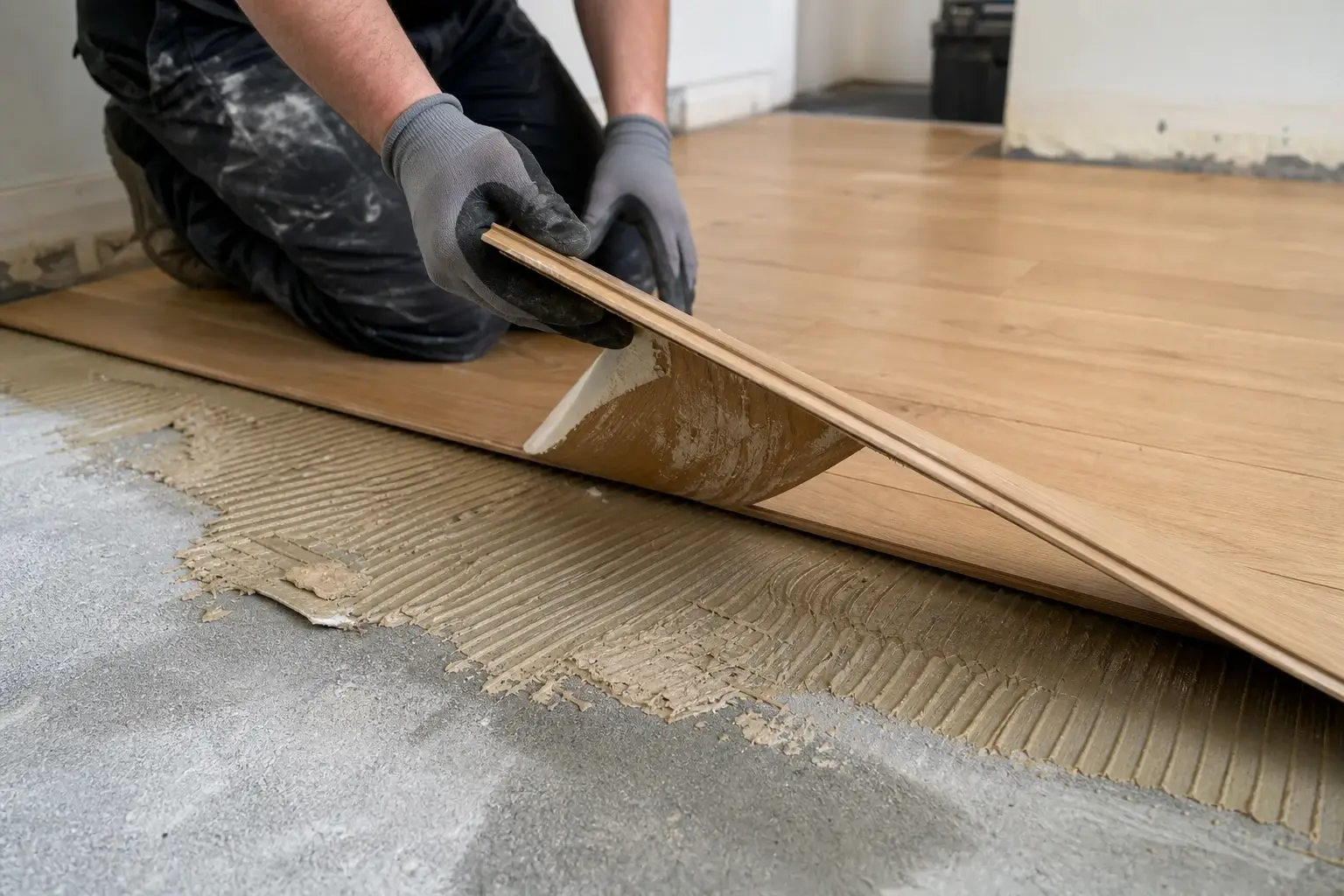
If a floor starts lifting, sounding hollow or feeling loose, the adhesive is often one of the first things people suspect. Sometimes that is right. The wrong flooring adhesive, or adhesive that has been used incorrectly, can contribute to a floor failing much sooner than expected.
But the visible symptom does not tell you the full story. Similar problems can also be linked to moisture, poor subfloor preparation, movement in the substrate, incompatible materials or installation conditions that were not suitable on the day. That is why a careful inspection matters before anyone draws conclusions.
How adhesive problems can affect a floor
Adhesive is meant to do more than simply stick flooring down. It needs to suit the floor covering, the subfloor and the conditions in the room, and it needs to be applied correctly. If any of those parts are wrong, the bond can weaken.
In practice, this can lead to:
- lifting at the edges or corners
- areas that sound hollow when walked on
- soft or loose patches underfoot
- open seams or gaps developing in some floor types
- early movement, cracking or distortion
These signs may point towards a bonding issue, but they do not prove that the adhesive is the only cause. In many cases, the adhesive is part of a wider failure chain rather than the sole fault.
What “wrong adhesive” can mean in real terms
The phrase wrong flooring adhesive can cover several different problems. It may mean the adhesive was not suitable for the flooring product, the subfloor or the environmental conditions. It may also mean the adhesive was the right type but was applied badly, left to cure in poor conditions or spread over a surface that had not been prepared properly.
Examples can include:
- using an adhesive not compatible with the flooring material
- using a product that was not suitable for the subfloor type
- applying adhesive to a dusty, weak or contaminated surface
- fitting flooring when moisture levels were too high
- not allowing the adhesive to be spread, flashed off or cured as required
- using the wrong trowel size or insufficient coverage
Any of these can reduce bond strength. In some cases the failure may appear quickly; in others it may develop gradually as the floor is used.
Visible signs that may suggest a bonding problem
Some symptoms commonly associated with adhesive failure include:
- flooring lifting after installation
- hollow sounds when tapped or walked over
- loose edges that can be pressed down and rise again
- movement that was not present soon after installation
- wrinkling, rippling or localised distortion in some products
However, these signs are not specific to adhesive alone. For example, hollow or loose flooring can also be linked to poor subfloor flatness, insufficient preparation or moisture-related issues. If the floor is timber, movement in the boards or substrate can create similar symptoms. If it is carpet, a loose feel or rippling may involve stretching, seams or installation technique rather than adhesive failure.
That is why it is important not to assume that what you can see on the surface tells the whole technical story.
Why moisture and subfloor condition matter so much
Adhesive performance depends heavily on what is beneath the flooring. Even a good adhesive may struggle if the subfloor is too damp, too uneven or not properly prepared.
Moisture can affect adhesion directly and can also change the behaviour of the floor covering itself. A damp screed or an unsuitable substrate can prevent a stable bond from forming. Similarly, a floor laid over an uneven or friable base may not make consistent contact, which can leave weak spots from the start.
If you want to understand this wider context, these articles may help:
- Why subfloor flatness matters before flooring is installed
- Why moisture problems can show up after a new floor is installed
- Why flooring can sound hollow or feel loose after installation
Those issues often overlap. A floor may have been fitted with the wrong adhesive, but the underlying reason for failure may still involve substrate condition or moisture levels.
Why visual checks are rarely enough
A floor can look as though the adhesive has failed, when the real issue lies elsewhere. Equally, a problem may begin with adhesive selection but only become obvious once the floor starts moving or the subfloor condition worsens.
An independent inspection can help by looking at the floor as a system: the covering, adhesive, substrate, moisture condition, installation details and the visible pattern of failure. That evidence-based approach is often the most reliable way to narrow down the cause.
If the issue is disputed, it can also be useful to gather records such as product details, installation notes, photographs and any moisture readings before speaking to an inspector. Our guide to what evidence to gather before asking for an independent flooring inspection explains this in more detail.
When to ask for an independent inspection
If a floor is failing and the reason is not obvious, an independent inspection is usually worth considering. This is particularly important where there is a complaint, a dispute between parties or a need for a formal written report.
The Flooring Inspector provides impartial flooring inspections across England, Scotland and Wales, including investigations into adhesive-related failures, moisture concerns, subfloor problems and installation defects. If you are dealing with an unresolved issue, you can request a call back so the problem can be discussed before a quotation for inspection is prepared.
In short, adhesive can be the cause of a flooring failure, but it is rarely sensible to assume that from appearance alone. The wrong product, poor application, moisture, lack of preparation or substrate problems can all produce similar symptoms. A proper inspection is the best way to establish what is actually going on.