
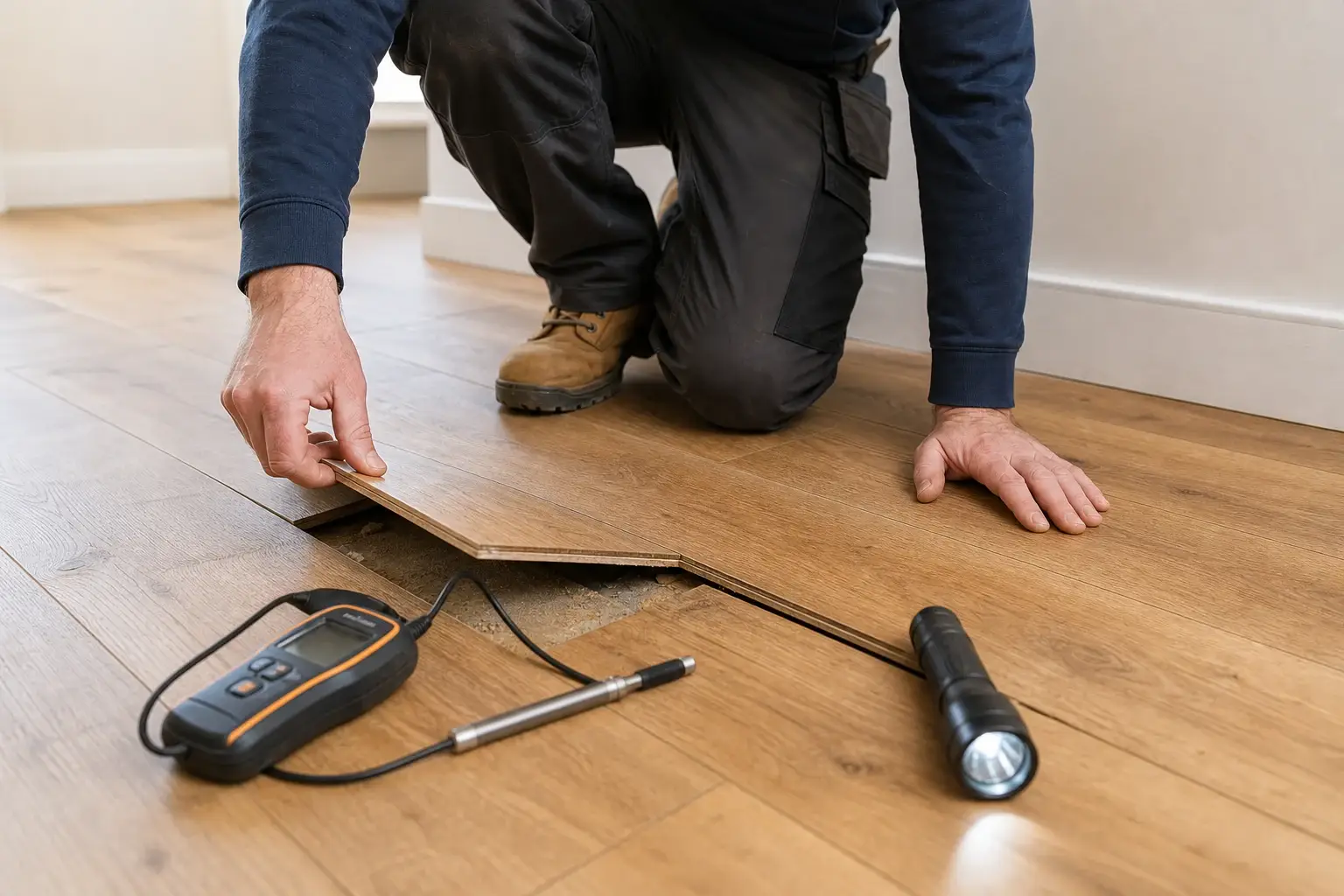
If flooring sounds hollow or feels loose after installation, it does not automatically mean the same thing has gone wrong in every case. A drummy sound, a soft patch or a slight give underfoot can all arise from different issues, and the underlying cause is not always obvious without inspection.
In practical terms, those symptoms usually suggest that the flooring is not behaving as a properly supported, well-bonded system. That may involve the floor covering itself, the adhesive or fixing method, or the substrate below. In some cases, the problem is minor. In others, it can point to a more significant installation or subfloor issue that may worsen over time.
What a hollow sound or loose feeling may indicate
A hollow sound often means there is a gap, void or lack of solid contact somewhere in the floor build-up. A loose feel can mean the flooring is moving relative to the surface below, or that the subfloor itself is flexing, lifting or failing to support the finish properly.
Possible causes can include:
- poor adhesive coverage or insufficient bonding
- voids beneath tiles, boards, vinyl or other floor finishes
- an uneven or poorly prepared subfloor
- localised debonding between layers
- movement in the substrate below the flooring
- incorrect fixing methods for the product installed
- moisture-related problems affecting adhesion or substrate stability
That list is not exhaustive, and a similar sound can sometimes come from more than one issue at the same time.
Sound and movement are not always the same problem
It helps to separate what you can hear from what you can feel. A hollow noise underfoot may simply mean the flooring is not fully supported. A loose or springy sensation can suggest more active movement in the build-up below.
For example, a floor may sound drummy because of localised voids, but still feel reasonably firm. Another floor may seem secure at first glance, yet flex or shift because the subfloor below is not stable. That is why symptoms should be assessed together rather than treated as a single fault.
Where timber floors are involved, movement may also be linked with expansion, fixing detail or subfloor behaviour. In some cases, noisy or mobile boards can be part of a wider issue with the structure beneath. Why timber floorboards squeak or move, and when it may be a problem explains some of the related signs.
Common installation-related causes
One of the most frequent reasons for a hollow or loose feel is poor preparation. If the substrate was not flat, clean, dry or stable enough before installation, the flooring above may not have been able to bond or support itself as intended.
Adhesive-related issues can also be involved. If too little adhesive was used, if it was not applied evenly, or if the wrong product was chosen for the flooring and substrate combination, the result can be partial bonding and hollow areas. With some floor types, insufficient coverage may not show immediately but can become more noticeable after use.
Subfloor conditions matter too. Cracks, weakness, contamination, excessive moisture or levelling problems can all affect how the finished floor performs. Why subfloor cracks matter, and when they may affect flooring performance looks at one aspect of that. If moisture is suspected, it is important not to guess: moisture testing may be needed to understand whether the substrate is suitable and whether the flooring system has been compromised. Why moisture readings are important before installing new flooring covers that in more detail.
Why it is unwise to assume the cause
The same symptom can arise from very different faults. A hollow patch might be caused by adhesive failure, but it could also be linked to levelling, a weak screed, poor substrate preparation or movement elsewhere in the construction. A loose feeling may come from the floor covering, but it may also reflect the layer below it.
That is why it is usually better to look for evidence rather than rely on guesswork. If the issue is part of a dispute, it can also help to gather photographs, installation details and any communication about the problem before an inspection is arranged. What evidence to gather before asking for an independent flooring inspection sets out what may be useful.
When an independent inspection may be needed
If the floor is getting worse, if the problem covers a wider area, or if there is disagreement about what caused it, an independent flooring inspection can help identify the underlying issue. A proper inspection can assess the flooring, the subfloor and the visible signs together, rather than focusing on one possible explanation.
That is particularly useful where responsibility is unclear between installer, retailer, manufacturer or other parties. An impartial report can provide evidence-based findings and practical recommendations without assuming fault before the facts are known.
If you are dealing with a floor that sounds hollow or feels loose after installation and the problem has not been resolved, it may be sensible to request a call back. The Flooring Inspector provides independent inspections and reports across England, Scotland and Wales, including on-site and remote assessments where appropriate.
You can also read how to tell whether a flooring problem needs an independent inspection or just a complaint if you are deciding on the next step.