
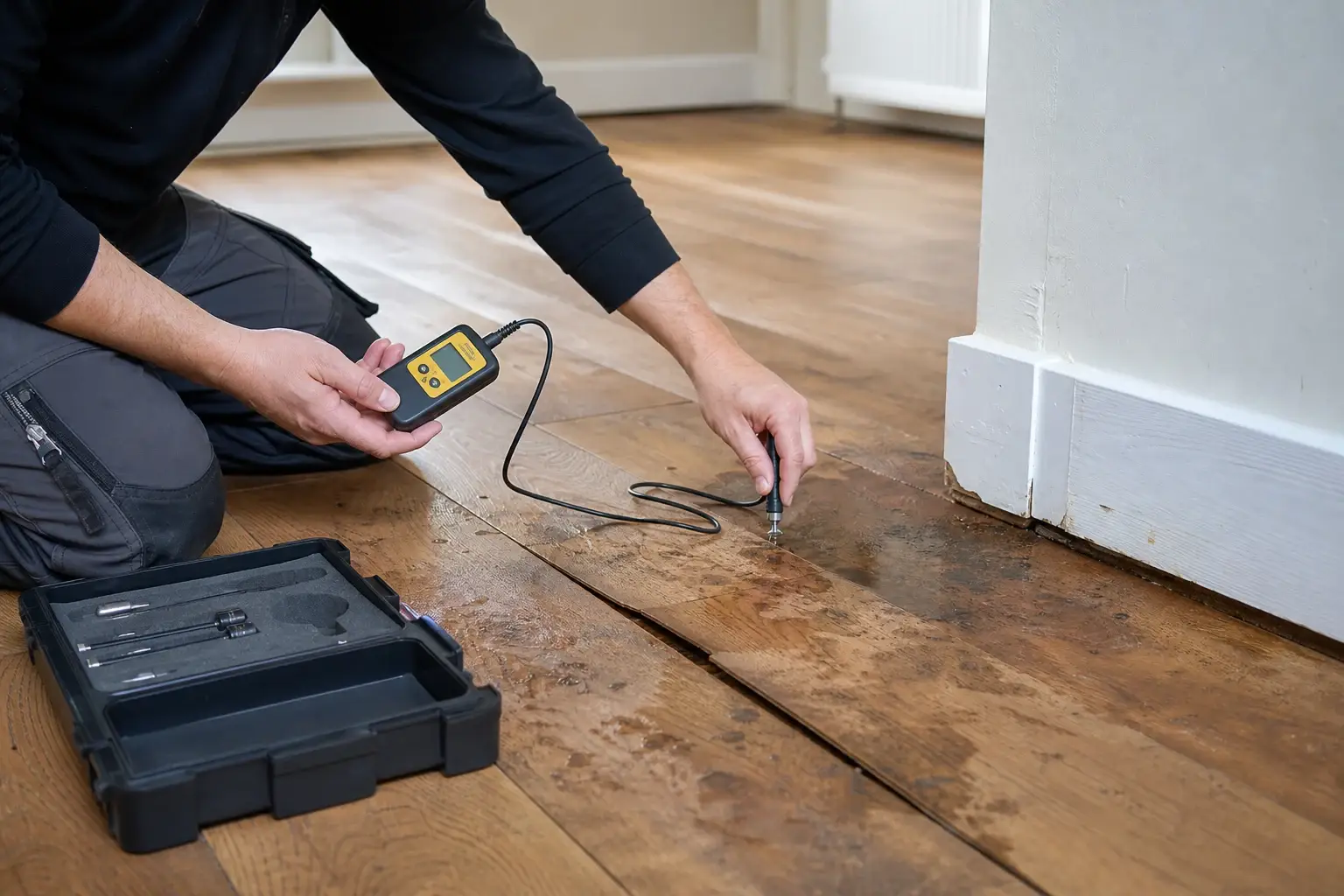
A floor can look perfectly acceptable on the day it is handed over and still go on to develop problems shortly afterwards. When that happens, moisture testing after installation may help show whether moisture was already present in the structure, whether conditions changed after fitting, or whether the floor system was not suited to the environment it was installed into.
That matters because visible symptoms alone do not usually tell the full story. Lifting, edge movement, staining, hollow sounds, bubbling, bond failure and distortion can all be associated with moisture, but they can also have other causes. An impartial inspection can help separate what is visible from what is actually driving the problem.
Why a floor problem may only appear after installation
Many moisture-related issues become obvious only once a floor covering has been installed and the space starts to be used normally. A subfloor that was marginally damp, for example, may not show anything obvious at first. Once a floor is laid over it, the trapped moisture may begin to affect adhesives, finishes, boards or joints.
In other cases, the floor itself is not the issue. The problem may lie with the substrate, the preparation, the adhesive, the ambient conditions in the room, or the way the flooring system responds to moisture once it is in service. That is why a post-fit inspection should not begin with a guess. It should begin with evidence.
For readers dealing with a disputed installation, it can also help to compare the symptoms with the broader picture of the work carried out. Guidance such as moisture testing before flooring goes down: the checks that matter is useful background, because it shows what should normally be considered before a floor is installed in the first place.
What post-installation moisture testing can help reveal
Testing after installation cannot rewrite what happened before the floor was fitted, but it can still provide valuable information. Depending on the floor type and the failure pattern, it may help identify:
- whether the subfloor is showing elevated moisture levels
- whether conditions inside the room are outside the range the floor was designed for
- whether moisture may be affecting the adhesive bond
- whether a timber floor is reacting to moisture movement
- whether staining, discolouration or surface damage may be moisture-related
- whether further investigation into the substrate, ventilation or heating regime is needed
For some floors, moisture is not the only factor to consider. Flatness, contamination, poor preparation and installation tolerances can all interact with damp conditions. If the floor is also lifting or separating at joints, it may be sensible to look at related symptoms alongside moisture testing. Our article on click LVT that separates at the joints explains how different issues can produce similar visible signs.
Why appearance alone is rarely enough
A stained patch does not automatically prove a damp substrate. A lifting edge does not automatically prove adhesive failure. A hollow sound does not automatically mean the floor was badly fitted. In practice, flooring defects often overlap.
For example, moisture may weaken adhesion, but poor surface preparation can make the same area more vulnerable. A floor may start to cup, ripple or blister because of moisture movement, but the underlying route for that moisture may be connected to the building fabric, the subfloor, or environmental conditions in the room.
That is why evidence needs to be built from more than one source. An inspection may consider the floor finish, the substrate, the pattern of damage, the room conditions, the fitting method, the surrounding environment and any available installation history. In a disputed case, that broader context is often what matters most.
Signs that moisture may be part of the problem
Some of the more common signs that may point towards moisture-related flooring issues include:
- edge lift or localised lifting
- bubbling, blistering or tenting
- changes in shape, such as cupping or crowning in timber
- gaps opening or closing seasonally
- staining, darkening or discolouration
- movement at seams or joins
- a change in the way the floor sounds or feels underfoot
These symptoms can be caused by more than one mechanism, so they should be treated as clues rather than proof. If the floor is timber-based, it may be worth reading why moisture problems can show up after a new floor is installed, which looks at why faults often become visible only after the fitting work is complete.
When an independent inspection can help
If the floor has been installed recently and the cause of the problem is being disputed, an independent inspection can help establish what is happening before positions harden. That is especially useful where there are competing views between homeowner, contractor, retailer, manufacturer or insurer.
An impartial inspector can assess the visible defect, examine the likely moisture pathways, consider the installation context and produce a written report based on findings rather than assumptions. In some cases, that may be enough to clarify the issue. In others, it may point to the need for further targeted testing or a broader subfloor investigation.
If the matter is unresolved, it is sensible to gather records such as installation notes, product details, photographs and any correspondence before asking for help. A written inspection record is often more useful when the history is clear.
At The Flooring Inspector, post-installation problems are assessed independently and without siding with any party. Where a floor has failed, or may be starting to fail, moisture testing after installation can be one part of working out whether the issue lies in the floor covering, the substrate, the installation or the conditions the floor is now operating in.
If you are dealing with a problem that appeared after fitting, a call back request is often the simplest first step. A member of the team can discuss the issue and advise whether an inspection and quotation are appropriate.