
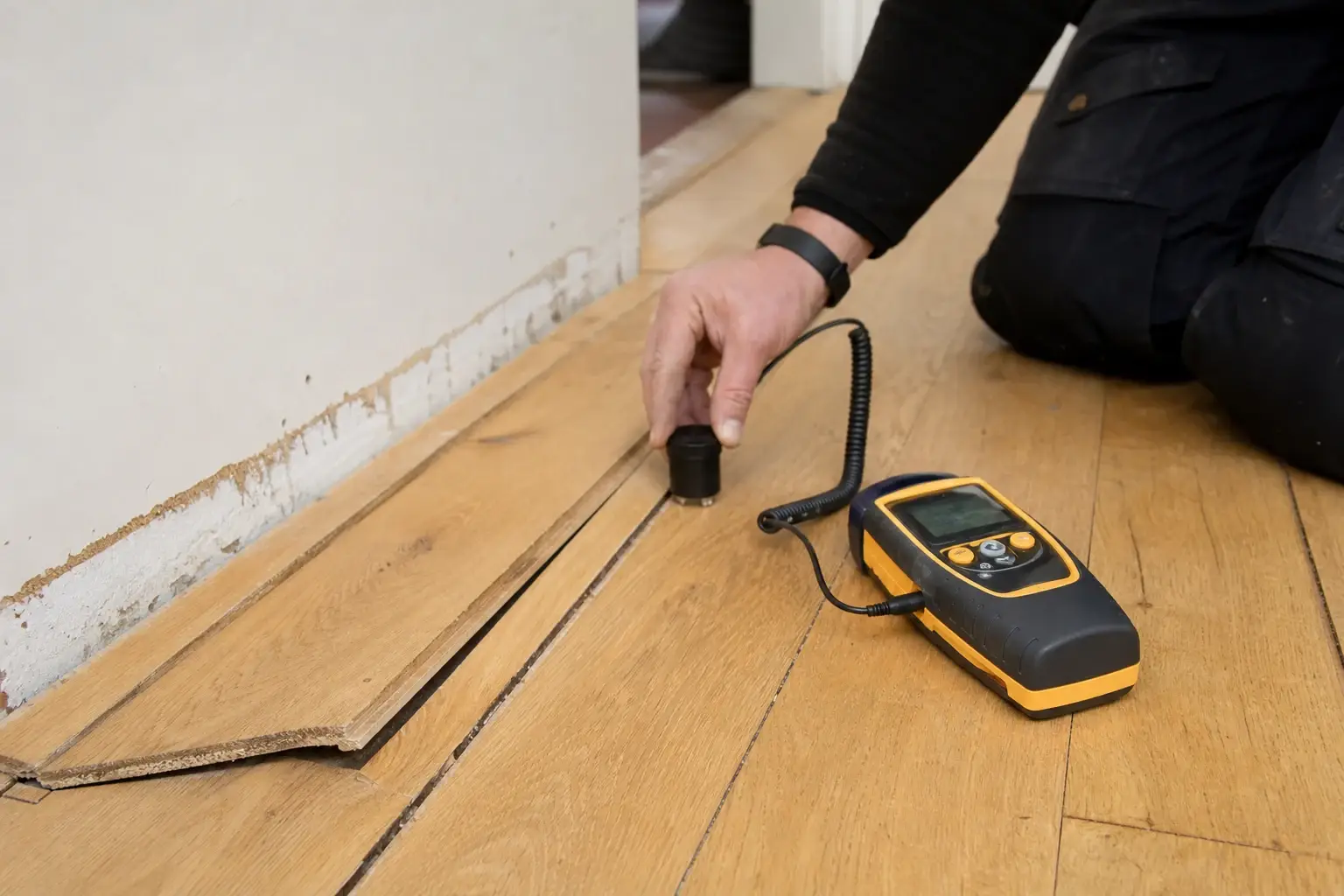
A floor can look perfectly serviceable and still give moisture readings that suggest a problem. The opposite can happen too: visible signs such as staining, edge lift, cupping or bubbling may be present even where a quick reading seems unremarkable. That mismatch is one reason appearance alone is not a reliable way to judge flooring risk.
In practice, moisture-related flooring problems are rarely decided by one clue. A proper assessment usually looks at the floor finish, the subfloor, the room conditions, the type of product fitted and the way it was installed. When those pieces do not line up, an independent inspection can help work out what is actually happening.
Why the floor can look dry when moisture is still present
Moisture does not always announce itself with obvious surface signs. A concrete subfloor may appear clean and dry at the top while retaining moisture deeper within the slab. Timber substrates can also hold moisture unevenly, so one area may seem stable while another is affected.
That is why a visual check on its own can miss underlying conditions that matter to flooring performance. A floor finish may still look neat, but the substrate beneath it could be creating risk for adhesive failure, movement or distortion. This is especially relevant where the flooring has only recently been installed, because a floor can look fine for a period before problems begin to show.
For more on that pattern, see why moisture problems can show up after a new floor is installed.
Why visible damage does not always mean the moisture reading is high
A floor may look as though moisture is the obvious cause, but the readings may not be straightforward. Visible distortion can be linked to several different issues, including installation defects, movement in the subfloor, unsuitable adhesive, lack of expansion space or previous environmental changes. In other words, a damaged-looking floor is not proof of a wet subfloor.
This is one reason moisture readings need to be interpreted alongside the condition of the floor. A localised issue at the edges, joints or doorway may reflect a specific installation or movement problem rather than a general moisture problem across the whole room.
If the visible symptoms include lifting around the perimeter, this article may also help: perimeter lifting in flooring: the clues that help narrow the cause.
Factors that can affect how readings and appearance line up
Several things can influence whether moisture readings appear to match what you can see:
- The location of the test – one reading may not represent the whole floor.
- The type of subfloor – concrete, screed and timber behave differently.
- The flooring system – wood, carpet, LVT and other finishes respond differently to moisture.
- Environmental conditions – heating, ventilation and seasonal changes can alter both the floor and the readings.
- Previous drying or repair work – a surface may have changed since the problem first appeared.
- Testing method and timing – results can differ depending on how and when the test is carried out.
That is why the same floor can produce confusing evidence. A floor may seem visually stable yet still be outside the conditions the flooring needs to perform properly. Or it may look affected, while the issue turns out to be something other than moisture.
If the floor has already started to sound hollow, feel loose or lift, an article on why flooring can sound hollow or feel loose after installation may also be relevant.
What to do when the evidence does not agree
When the appearance and the readings do not match, the next step is usually not to guess. It is to gather more evidence. That may involve checking the pattern of the visible defect, confirming the flooring type, reviewing the installation history and carrying out further moisture-related investigation in the right places.
An impartial inspection can help separate what is seen on site from what is actually causing the problem. That matters in unresolved complaints and disputes, because a single reading or a single visible symptom rarely tells the full story on its own.
If you are dealing with a disputed floor and the evidence seems to point in different directions, The Flooring Inspector provides independent inspections and reports across England, Scotland and Wales. Where appropriate, this can include moisture-related investigations designed to identify the underlying cause rather than relying on appearance alone.
For a related overview of the checks involved before flooring is fitted, see moisture testing before flooring goes down: the checks that matter.