
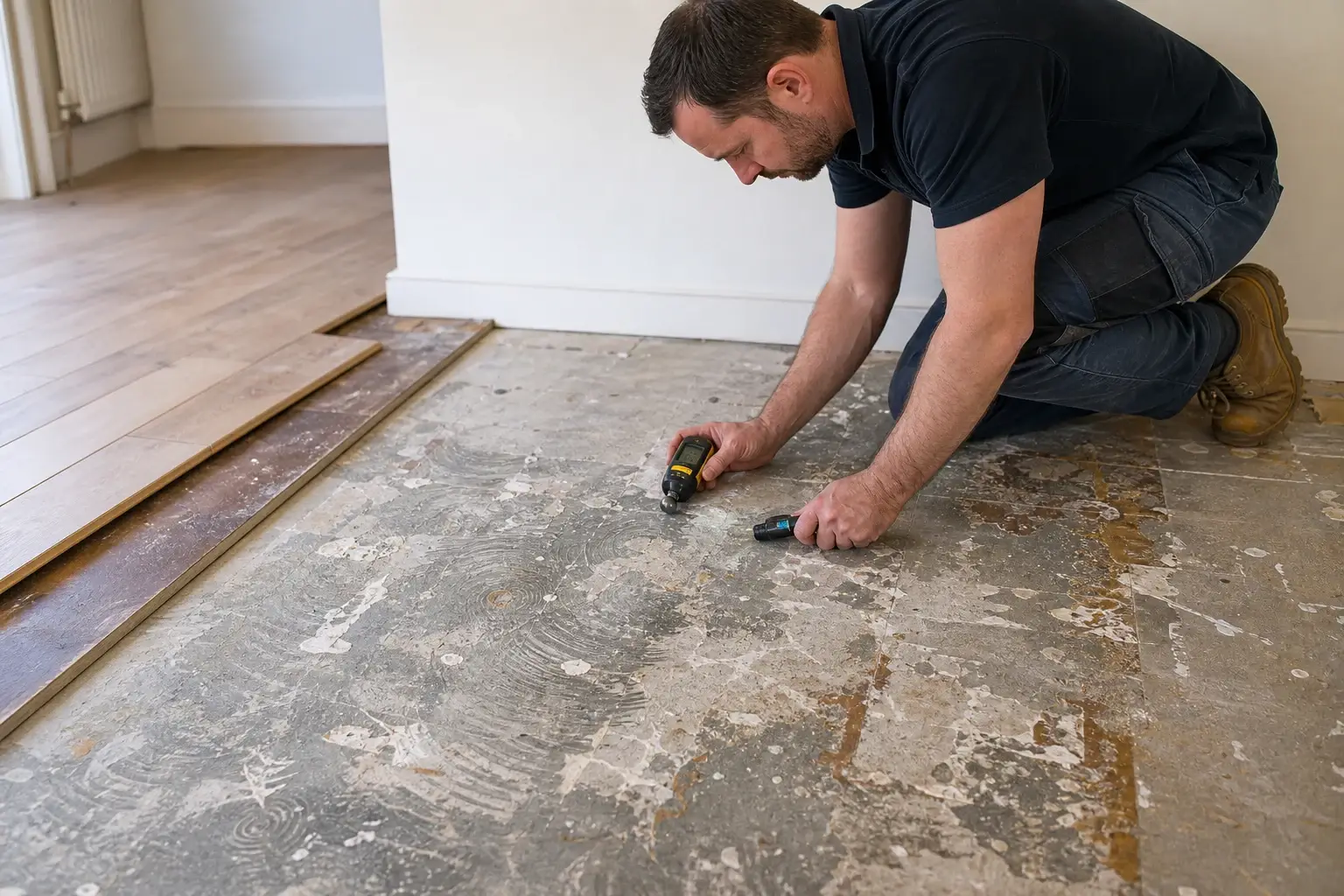
Subfloor contamination can cause problems long after a floor has been installed. Dust, plaster, paint, adhesive residue and other debris may not look serious at first glance, but they can interfere with bonding, levelling and the way a finished floor performs over time.
That is why a floor that starts lifting, rocking, hollowing, cracking or showing uneven wear does not always point to the product itself. In some cases, the real issue is what was left on the subfloor before the new flooring went down.
What counts as subfloor contamination?
Subfloor contamination is any material on the substrate that should have been removed or controlled before flooring installation. Common examples include:
- dust and loose debris
- paint splashes or old coatings
- plaster, filler or jointing compound residue
- old adhesive remnants
- grease, oil or other surface contamination
- construction debris left behind after preparatory works
The problem is not always visible once the floor is installed. A subfloor may look clean enough during a brief site visit, but still carry enough residue to affect how primers, adhesives, smoothing compounds or floor coverings perform.
How contamination can affect flooring performance
Different contaminants can cause different issues, but the main concern is that they can prevent proper contact between layers. If adhesive bonds to dust rather than to the subfloor itself, the fixing may be weaker than intended. If a levelling compound is applied over a poorly prepared surface, it may not bond correctly or may separate later.
That can lead to problems such as:
- lifting or debonding
- hollow-sounding areas
- soft or unstable patches underfoot
- uneven or failed levelling compound
- visible ridging, cracking or surface movement
- premature wear in affected areas
With some flooring types, the effect may not be immediate. A floor can appear satisfactory when first completed and only later show signs of failure as foot traffic, environmental changes or moisture interact with the contaminated substrate.
If you are also seeing sounds or movement underfoot, this article may be useful: why flooring can sound hollow or feel loose after installation.
Why dust is not as harmless as it looks
Dust is one of the most common forms of subfloor contamination, and it is often underestimated. A fine layer of dust can act as a barrier between the substrate and the adhesive or smoothing compound. In practical terms, that can reduce bond strength and affect how well the floor system performs.
This is especially relevant where an installation relies on full adhesion. If the surface was not properly vacuumed, primed or prepared, the finished floor may not be attached as intended. Visual inspection alone does not always reveal whether the bond has failed because of dust contamination, another preparation issue, or a separate problem altogether.
Paint, plaster and adhesive residue can create different risks
Paint and plaster residue may seem minor, but they can leave a surface that is uneven, friable or unsuitable for direct bonding. Old adhesive residue can be even more complicated. Depending on the product involved, it may be stable, soft, brittle or chemically incompatible with the new installation.
That is one reason why a failed floor should not be judged by appearance alone. Two areas may look similar from above while having very different substrate conditions beneath the surface.
For example, if the floor is showing signs of edge lift or movement, the cause could relate to contamination, moisture, poor preparation or another installation issue. An inspection is usually needed to work through those possibilities. You may also find this relevant: why flooring can fail when the wrong adhesive is used.
Why levelling compounds can be affected too
Contamination does not only affect the final floor covering. It can also compromise levelling and smoothing products used during preparation. If the substrate is dusty, contaminated or poorly cleaned, a levelling compound may not bond properly and could crack, de-bond or break down in service.
That can become important when trying to understand whether a fault lies with the floor covering, the preparation stage, or both. Where levelling work has been carried out, an inspection may need to consider:
- the condition of the substrate before the compound was applied
- whether contamination was present
- what preparation methods were used
- whether compatible primers or bonding agents were used
- whether the later floor failure matches a preparation defect
Why a visual check is often not enough
Subfloor contamination is not always obvious from the finished floor surface. Even when a problem is visible, the cause may still be unclear. Lifting, cracking or movement could point to contamination, moisture, inadequate flatness, poor substrate preparation, unsuitable adhesive or several issues together.
That is why an independent inspection can be so useful. A flooring inspector can assess the visible symptoms, review the installation conditions and examine the likely substrate-related causes without assuming blame in advance.
If you are unsure whether your issue is something that needs a complaint or a technical inspection first, this guide may help: how to tell whether a flooring problem needs an independent inspection or just a complaint.
When to consider an independent inspection
An independent inspection may be appropriate if:
- a new floor has failed soon after installation
- you suspect the subfloor was not properly prepared
- there are signs of lifting, hollow areas or movement
- levelling work has failed or looks uneven
- there is a dispute about whether the substrate was suitable
- you need impartial evidence for a complaint, insurer or legal adviser
At The Flooring Inspector, inspections are carried out independently from manufacturers, suppliers and installers. The aim is to identify the underlying cause of the problem and provide clear, evidence-based findings that can help you understand what has happened next.
If you are dealing with an unresolved flooring issue, you can request a call back through the contact page so the team can discuss the problem before a quotation for inspection is prepared.