
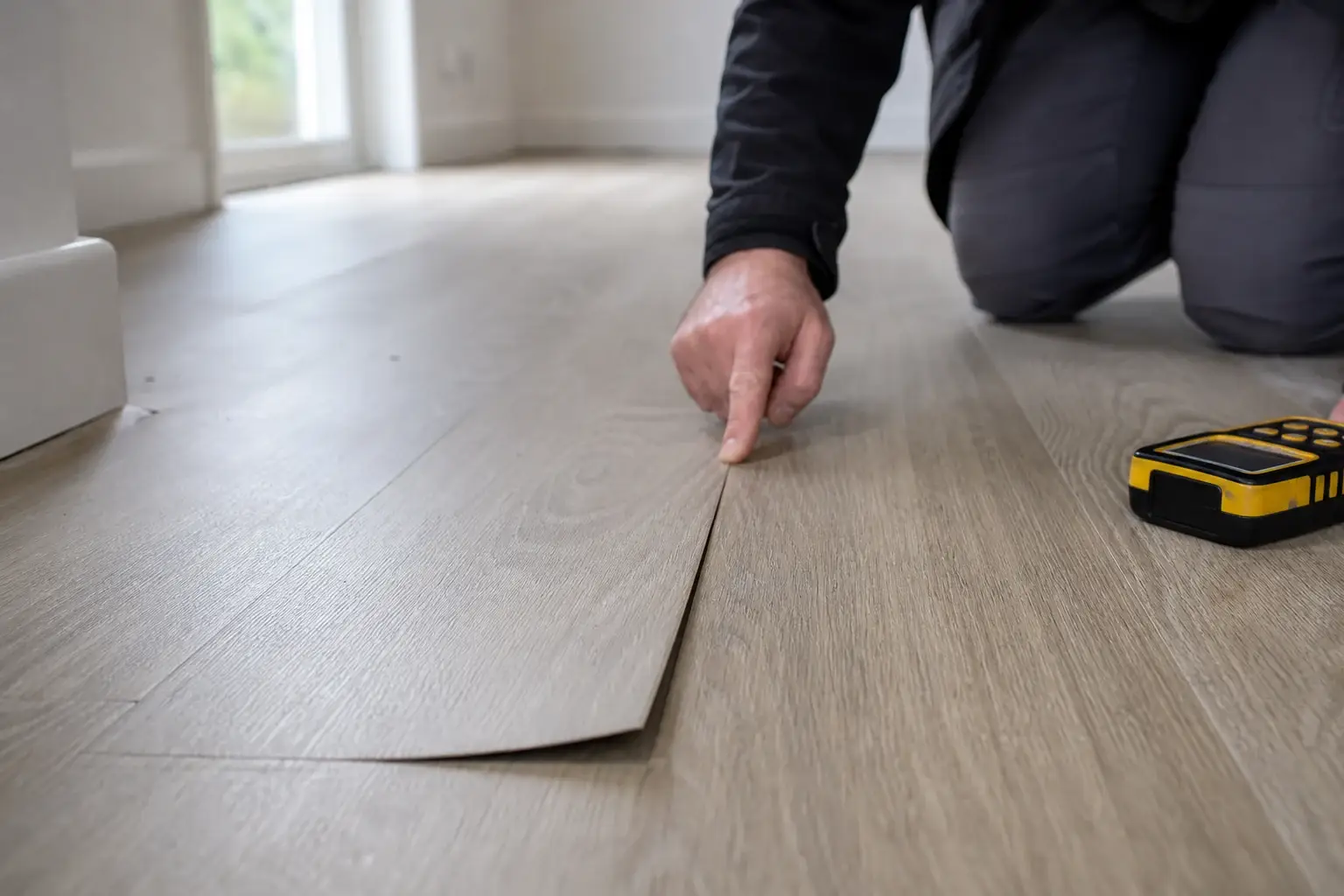
Click LVT edge curl, peaking and distorted joints are warning signs that something in the floor system may not be behaving as intended. They do not automatically mean the product is defective, and they do not automatically mean the installation is at fault either. Several different issues can produce similar-looking symptoms, which is why visual appearance alone rarely tells the full story.
In plain terms, edge curl is when the edge of a plank or tile starts to lift or turn upward. Peaking is often used when adjacent planks form a slight ridge, usually where the joints are under stress. Joint distortion can include visible gaps, raised edges, misaligned joints or a floor surface that no longer looks flat and even at the seams.
What these symptoms can suggest
When click LVT starts to show edge curl or peaking, the floor may be responding to movement somewhere in the system. That movement could be in the product itself, the substrate below it, or the room conditions around it. In some cases, the floor may be trying to expand but has been restricted. In others, the issue may be linked to an uneven subfloor, poor support, or installation tolerances that were too tight from the outset.
It is also possible for environmental conditions to play a part. Changes in temperature and humidity can affect many flooring systems, especially where the floor is close to a moisture source, underfloor heating or a space with unstable conditions. The same visible symptom can therefore have several possible causes.
Common possible causes behind click LVT joint problems
A proper inspection usually needs to look at more than the floor surface. Relevant checks may include:
- Expansion allowance: if the floor has been fitted too tightly against walls, thresholds or fixed objects, it may have less room to move naturally.
- Subfloor flatness: an uneven substrate can put stress into the joints, especially in click systems that rely on even support.
- Moisture-related movement: moisture in the subfloor or surrounding environment can affect dimensional stability and performance.
- Installation tolerances: small variations in fitting, layout or preparation can sometimes show up later as joint distortion.
- Traffic and loading: heavy use, furniture movement or localised loading can contribute to wear or movement at vulnerable points.
- Product compatibility: some floors are more sensitive than others to the conditions they are installed in, particularly where underfloor heating is involved.
If the floor is also separating at the joints, it may be helpful to read Click LVT that separates at the joints: signs to watch and possible causes. Distortion and separation can overlap, but they do not always have the same underlying cause.
What you can check without making assumptions
Before anyone starts guessing at blame, it helps to note the pattern of the problem. Is the curl limited to one area, or spread across the room? Does it appear near windows, doors, radiators or external walls? Has it appeared after a weather change, a period of heating use, or cleaning and maintenance?
Useful observations include:
- where the distortion first appeared
- whether it is getting worse
- which direction the affected planks run
- whether doors, thresholds or skirting are involved
- any visible signs of moisture, staining or mould
- whether the floor feels hollow, loose or springy in places
That said, a neat-looking surface around the defect does not mean the floor below is sound. Some subfloor or moisture issues are not obvious from above.
Why a visual check is rarely enough
Click LVT is designed to lock together, but the visible joint line is only one part of the performance picture. A distorted joint could reflect a local fitting issue, a substrate problem, movement at the perimeter, or a wider installation failure. Because several causes can produce similar symptoms, a conclusion based only on photos or a brief site visit may be unreliable.
If the issue is disputed, or if the retailer, installer, landlord or homeowner is seeing different things from the same floor, an impartial inspection can help establish what is actually present and whether the evidence points towards product behaviour, installation quality, subfloor conditions or a combination of factors.
The Flooring Inspector carries out independent click LVT investigations across the UK, including on-site inspections, remote assessments and formal written reports where appropriate. For broader flooring defect work, the Inspection Services page explains the types of assessments available.
When an independent inspection may be the sensible next step
It may be worth arranging an inspection if the floor is continuing to distort, if the problem has spread, or if the cause is still being argued after initial complaints. An independent assessment can help clarify what is visible, what measurements or tests are relevant, and whether the symptoms are consistent with movement, moisture, preparation issues or installation tolerances.
If you are gathering evidence first, this guide may help: What evidence to gather before asking for an independent flooring inspection. In unresolved cases, a proper record of the symptoms can be useful before anyone removes or repairs the floor.
Edge curl, peaking and joint distortion should be treated as signs that the floor needs attention, not as proof of a single fault. The most useful next step is usually a calm, evidence-led inspection that looks at the full floor build-up, not just the surface appearance.