
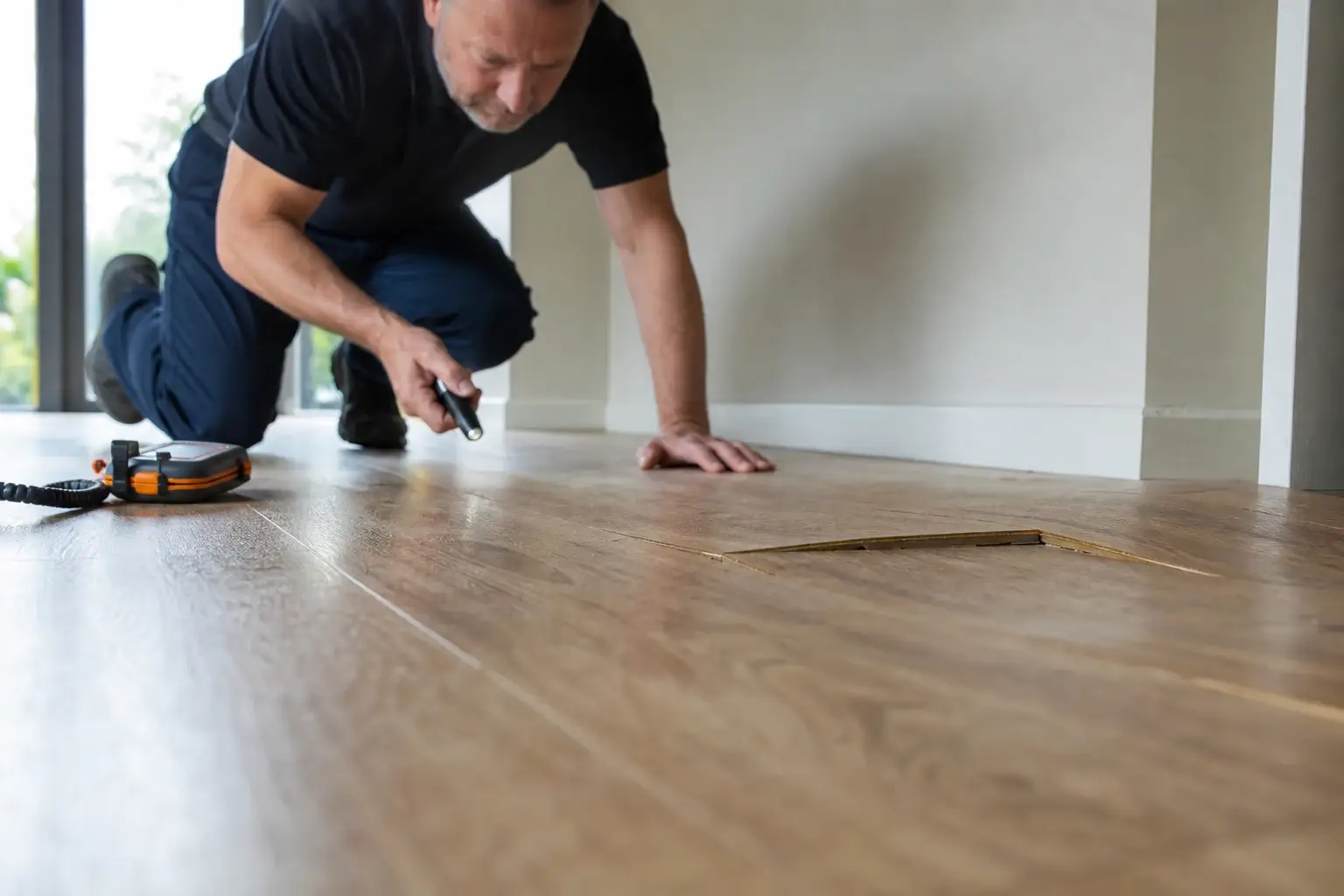
When a floor has too little room to move, it may start to push against walls, skirtings, thresholds or fixed fittings. That can contribute to visible movement, edge stress, lifting or, in some cases, buckling. But small expansion gaps do not automatically explain every failed floor. Other issues can produce similar symptoms, which is why the cause should be investigated rather than assumed.
What expansion gaps are meant to do
Many flooring products, especially wood and timber floors, need space around the perimeter to allow for normal movement. Flooring can expand and contract as temperature and moisture conditions change. The expansion gap is there to reduce the risk of the floor becoming trapped when that movement happens.
If the gap is too small, missing or bridged by adhesive, trims or sealant in the wrong place, the floor may lose the freedom it needs to move safely. In floating floor systems, that can create pressure across the boards or planks. In fixed floors, the effect may be different, but the principle is similar: movement is restricted, and the stress has to go somewhere.
What signs may suggest the gap is too small
Visible signs can vary depending on the floor type, the room conditions and how the installation was carried out. Possible symptoms include:
- lifting at edges or ends
- boards or planks pushing tightly against skirting boards
- gapping in some areas and compression in others
- tenting or buckling, where the floor appears to rise
- movement at thresholds or doorways
- squeaking, clicking or stress noise in some cases
However, these signs are not unique to insufficient expansion gaps. A floor can show similar behaviour if moisture levels are too high, the substrate is not flat enough, the wrong adhesive was used, the product is not suited to the environment, or acclimatisation was inadequate before fitting.
Why small expansion gaps do not always tell the whole story
It is easy to look at a lifted floor and focus on the perimeter, but the real cause may be more complicated. For example, a timber floor can react to moisture movement in the boards or the subfloor. A floating floor can fail if the substrate has humps, dips or uneven support. A fixed floor may show stress if it was installed over conditions it was not designed for.
This is why a visual check alone is rarely enough to make a firm conclusion. An inspection needs to consider the flooring type, how it was installed, the room environment, the condition of the subfloor and any evidence of moisture-related change.
Where relevant, moisture testing, subfloor assessment and a review of installation details can help establish whether insufficient expansion gaps are part of the problem or simply one symptom among several. For more on the role of moisture in floor performance, see Why Are Moisture Readings Important Before Installing New Flooring?.
How an independent inspection can help
An impartial flooring inspection looks at the evidence before reaching a view. That matters in disputes, because the visible damage may not reveal the original cause. A professional inspection can help identify whether the problem is most likely related to expansion allowance, moisture, subfloor conditions, installation quality or a combination of factors.
If needed, the findings can be set out in a formal written report. That may be useful when a homeowner, contractor, retailer, landlord, insurer or solicitor needs clear technical evidence before deciding next steps.
If the floor is also lifting at the perimeter, you may find it useful to read Why timber floors can lift at the edges, and what it may indicate.
When to seek help
If a floor is already showing signs of movement, or if a newly fitted floor seems tight against the room edges, it is sensible to pause before making assumptions about blame or repair. An independent inspection can help determine what is actually causing the failure and whether the expansion gap is genuinely part of the issue.
The Flooring Inspector provides impartial flooring inspections across England, Scotland and Wales, including investigations into wood and timber floors, subfloors and installation-related failures. If you are dealing with an unresolved flooring problem, you can request a call back so the issue can be discussed before a quotation for inspection is prepared.